Last updated 2026-07-25
TL;DR
A certificate of analysis (COA) verifies purity, identity, and contaminant levels for a peptide vial. It cannot tell you whether AOD-9604 works for fat loss in humans, and the published trial record shows the weight-loss effect did not separate convincingly from placebo. Use a COA to screen out bad vials, not to judge efficacy.
What is a certificate of analysis, actually?
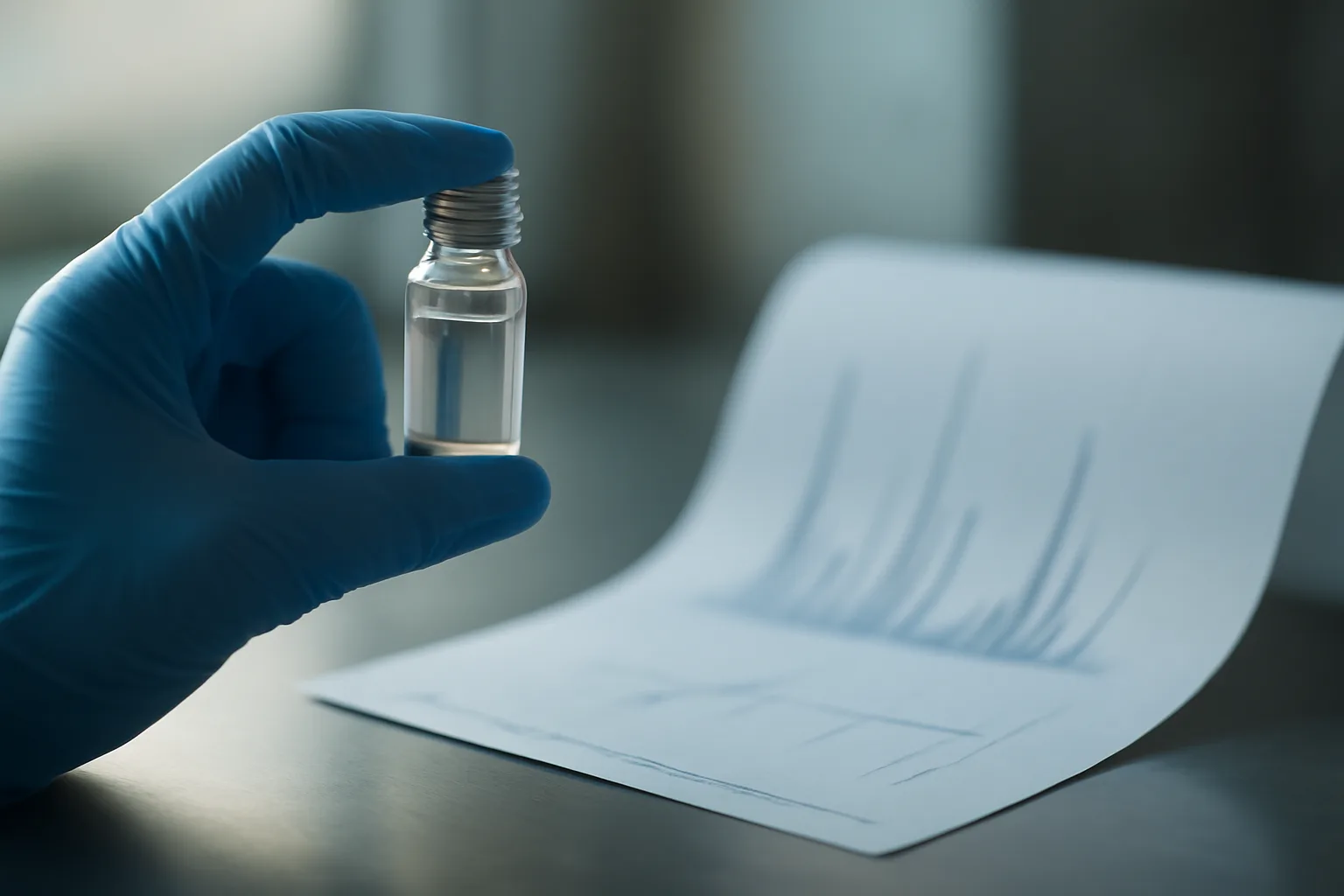
A certificate of analysis is a lab document that comes with (or should come with) a peptide vial. It states what a specific batch contains, at what purity, and what it doesn't contain. Think of it as a quality snapshot of one lot, not a verdict on whether the compound does anything useful in a human body. A typical COA lists the peptide identity (usually confirmed by mass spectrometry), purity by HPLC (often expressed as a percentage, like 98.5%), residual solvents, endotoxin levels, and sometimes microbial testing. Some COAs also list the exact peptide sequence or molecular weight, since that's how a lab confirms you're actually holding AOD-9604 and not something else entirely. Here's the part that trips people up: a clean COA proves the vial is what it claims to be. It says nothing about whether that peptide, dosed in a human, produces meaningful fat loss. Those are two completely separate questions, and vendors benefit when buyers conflate them. AOD-9604 itself is a 15-amino-acid fragment of human growth hormone, specifically the region of the GH molecule associated with fat metabolism, engineered to exclude the growth-promoting and insulin-resistance-inducing parts of the full hormone [1]. That's the whole rationale: take the piece of GH that supposedly drives lipolysis, leave out the piece that causes the side effects. It's a clever idea on paper. The clinical trial data is where it gets shakier, and we cover that below.
Why does a COA matter more for peptides than for typical supplements?
Peptides sold outside the FDA-approved drug pathway are not manufactured under the same enforcement regime as prescription medications. Nothing in the FDA's approved drug database lists an AOD-9604 product [research pack: Drugs@FDA]. That means there's no FDA-reviewed manufacturing standard, no mandated batch testing, and no agency inspecting the facility that filled your vial. AOD-9604 is not on the FDA's current list of bulk drug substances that can be used under 503A pharmacy compounding [2], and it's also absent from the separate 503B outsourcing facility bulk substances list [3]. Both lists are maintained under the Federal Food, Drug, and Cosmetic Act provisions on compounding, specifically 21 U.S.C. 353a [4]. Practically, this means a legitimate, provider-reviewed source matters more here than it would for, say, a bottle of vitamin C, because there's less regulatory backstop catching bad actors. Without federal batch oversight, the COA becomes the main piece of paper standing between you and a mislabeled or contaminated vial. That's exactly why it matters, and exactly why it's not enough on its own. A COA from a lab with no accreditation number, no batch ID, and no test date is worth approximately nothing. A real one has all three, plus a method reference (HPLC, LC-MS) and a signature or lab identifier you can actually trace.
What should a legitimate AOD-9604 COA actually contain?
A COA you can trust has specific, checkable fields. If any of these are missing or vague, treat the document as decorative rather than evidentiary.
| Field | What it should show | Red flag if missing |
|---|---|---|
| Batch/lot number | Unique ID tied to that specific production run | Generic or reused lot numbers across many products |
| Test date | When the sample was actually analyzed | No date, or a date far removed from packaging |
| Purity (HPLC) | A percentage, typically 98% or higher for research peptides | Purity stated with no method named |
| Identity confirmation | Mass spec or amino acid sequencing confirming it's AOD-9604 | Only a photo of a UV trace with no interpretation |
| Endotoxin level | Measured in EU/mg, relevant for injectable material | No mention of endotoxin testing at all |
| Testing lab name | A named, independent third-party lab | 'In-house lab' with no other detail |
The biggest tell is whether the lab is independent from the seller. A COA generated by the same company selling you the vial is not worthless, but it carries far less weight than one from a separate accredited lab with its own name and reputation on the line. Ask for the lab's name. If the seller won't give it, that's your answer.
Does a clean COA mean AOD-9604 works for fat loss?
No. This is the single most important thing to understand about a COA, and it's worth being blunt about it: purity and efficacy are unrelated questions. A 2004 review in Current Opinion in Investigational Drugs covering AOD-9604's development as a metabolic agent describes it as a modified fragment of hGH designed to retain the lipolytic (fat-metabolizing) activity of the parent hormone while avoiding the diabetogenic and growth-promoting effects [1]. That's the pitch, and it's a reasonable pharmacological hypothesis. But a hypothesis is not the same as a demonstrated clinical outcome. A separate 2006 review of obesity drugs in clinical development, also in Current Opinion in Investigational Drugs, placed AOD-9604 among a field of compounds being tested for weight management, at a stage well short of approval [5]. The honest summary of the human trial record, drawn from how AOD-9604 has been discussed in the literature since, is that the weight-loss signal in human obesity trials did not separate convincingly from placebo. That's the central fact anyone selling or buying this peptide for fat loss needs to sit with. A perfect COA changes nothing about that trial outcome. It only tells you that the vial you're holding matches its label, not that the compound inside will move the needle on your body composition. If you want the deeper comparison against a peptide with a stronger, FDA-approved evidence base for a related use, read aod 9604 vs tesamorelin. Tesamorelin has actual FDA approval for a specific indication (HIV-associated lipodystrophy), which is a different regulatory tier entirely from anything AOD-9604 has achieved.
How do labs actually verify peptide identity and purity?
The gold standard combines high-performance liquid chromatography (HPLC) for purity with mass spectrometry for identity confirmation. HPLC separates compounds by how they interact with a column, producing a trace where a single sharp peak suggests a pure sample and multiple peaks suggest contamination or degradation products. Mass spectrometry confirms the molecular weight matches what AOD-9604 should weigh. Since AOD-9604 is a small peptide fragment, it falls into a size range that analytical chemists have specifically developed methods for. A 2016 methods paper in the Journal of Separation Science describes a technique for screening peptides under 2 kDa (AOD-9604 is around 1.8 kDa) using direct urine injection combined with liquid chromatography and ion mobility mass spectrometry, developed specifically because small peptides are harder to detect with older screening methods [6]. That same analytical difficulty explains why the anti-doping world has spent real effort building better peptide detection methods generally [7] [8]. None of this analytical sophistication is something you can verify at home. You're trusting the lab's competence and honesty when you read a COA. That's why sourcing through a provider-reviewed channel, rather than an anonymous storefront, reduces one layer of risk, even though it can't fix the underlying trial-data problem.
Is AOD-9604 banned in sports, and does that affect sourcing?
AOD-9604 is a fragment of human growth hormone, which puts it in a regulatory gray zone for anti-doping purposes, and the research on detection is worth knowing if you're an athlete or just curious about the substance's status. A 2013 study in Drug Testing and Analysis specifically tested whether AOD-9604 interferes with the World Anti-Doping Agency's hGH isoform immunoassay, the test used to detect banned growth hormone doping. The study concluded that AOD-9604 does not influence the WADA hGH isoform immunoassay [9], meaning it wouldn't cause a false positive or negative on that particular test. That's a narrow, specific finding about one assay, not a statement about AOD-9604's legal status generally. Separately, a 2014 review in the Journal of Pharmaceutical and Biomedical Analysis covers analytical approaches for detecting emerging therapeutics and non-approved drugs in doping controls broadly, reflecting how much lab effort goes into catching substances like this in competitive sports [8]. A 2014 review in Expert Review of Proteomics covers detection of peptidic drugs, candidates, and analogs in sports doping specifically, again underscoring that peptide fragments are an active detection target [7]. If you compete under a testing body, this is a conversation for your governing body's anti-doping list, not something a COA will settle for you.
What does the clinical trial record actually say?
This is the part that matters most and gets buried most often. AOD-9604 went through human trials aimed at obesity treatment, and the results are the reason it never became an approved weight-loss drug. The compound has been through what industry reviews describe as "gateway" stages of clinical development, referenced across a series of pharmacology gateway papers tracking compounds moving through trial phases [10] [11] [12]. Moving through early trial gateways is not the same as demonstrating a clear, replicated weight-loss effect that beats placebo by a clinically meaningful margin. Based on how the compound is discussed in the metabolic and obesity-drug literature [1] [5], the honest read is that AOD-9604 has not produced trial results in which weight loss separated convincingly from placebo in human obesity studies. That's a specific, falsifiable claim, and it's the reason this peptide sits in research-chemical and off-label territory rather than on pharmacy shelves as an approved obesity drug. If the trial data had been strong, AOD-9604 would likely have followed a path toward FDA review rather than staying in the compounding gray zone it occupies now. Compare that against tesamorelin, which does carry FDA approval for a specific indication, covered in more detail on our aod 9604 vs tesamorelin page.
What about AOD-9604's use outside fat loss, like joint or tissue applications?
Some of the more recent peptide literature discusses AOD-9604 and related compounds in the context of musculoskeletal and orthopedic applications rather than obesity. A 2026 paper in the Journal of the American Academy of Orthopaedic Surgeons Global Research & Reviews covers therapeutic peptides in orthopaedics generally, discussing applications, challenges, and future directions for this drug class [13]. A related 2026 review in Sports Medicine covers safety and efficacy of approved and unapproved peptide therapies used for musculoskeletal injuries and athletic performance [14]. These papers reflect a broader research interest in peptide therapeutics for tissue and joint applications, a different use case entirely from the original obesity rationale AOD-9604 was designed around. Worth being clear here: interest in a research area is not the same as demonstrated efficacy for that use. If you're looking at AOD-9604 for a joint or recovery application rather than fat loss, the same COA logic applies unchanged. Purity documentation tells you what's in the vial. It doesn't validate the use case.
How do I check if a seller's COA is legitimate, more than present?
A COA existing is not the same as a COA being real. Sellers know buyers ask for COAs now, so fake or recycled ones have become common enough that a document alone shouldn't satisfy you. Cross-check the batch number against what's printed on the vial. If the seller can't produce a COA that matches the specific lot in your hand, and instead sends a generic "representative" COA, that's a real problem, not a technicality. Search the testing lab's name independently. A legitimate third-party lab has a findable name, address, and some public track record, even a basic one. If a lab name doesn't turn up anywhere outside that one seller's paperwork, be skeptical. Compare the purity percentage across multiple batches from the same seller. If every single COA reads exactly 99.1% purity for every product they sell, over years, that's a pattern of copy-paste documents rather than real per-batch testing. Real assay results have some natural variation, batch to batch. Given the compounding regulatory gaps described above [2] [3] [4], the most reliable move is buying through a provider-reviewed channel where a clinician or pharmacy partner has already done this verification work, rather than trying to audit a stranger's PDF yourself. AOD-9604 Co reviews providers and points readers toward a pharmacy-fulfilled, provider-reviewed sourcing route for exactly this reason: it shifts the verification burden off an individual buyer parsing chromatography traces alone.
What should I actually do with this information?
Read the COA to screen out an obviously bad vial: wrong identity, low purity, missing testing entirely. That's a real, useful filter, and skipping it is careless. Do not read the COA as evidence that AOD-9604 will produce meaningful fat loss. The trial record, as discussed by researchers tracking AOD-9604's development as a metabolic and obesity compound [1] [5], has not shown a weight-loss effect that clearly beats placebo in humans. That gap between purity documentation and clinical evidence is the single most important thing to carry away from this whole topic. If you're set on trying it anyway, go through a provider-reviewed source rather than an anonymous online seller, keep expectations modest, and pair it with basics that have actual evidence behind them (caloric deficit, resistance training, sleep). If you want a peptide with a stronger regulatory and evidence footing for a related use, the tesamorelin comparison is worth fifteen minutes of your reading time before you spend money on either one.
Frequently asked questions
What exactly does an AOD-9604 certificate of analysis prove?
It proves the tested batch matches its labeled identity and meets a stated purity threshold, usually via HPLC and mass spectrometry. It does not prove clinical safety or that the compound produces fat loss in humans. Purity documentation and efficacy evidence are separate questions, and a COA only answers the first one.
Is AOD-9604 FDA approved?
No. There is no AOD-9604 product listed in the FDA's Drugs@FDA database of approved drugs. It also does not appear on the FDA's current 503A or 503B bulk drug substance lists used for legal pharmacy compounding, which limits the legitimate channels through which it can be prepared and sold.
Did AOD-9604 pass human clinical trials for weight loss?
It moved through early clinical development stages, tracked in a series of pharmacology gateway reviews, but the weight-loss results did not separate convincingly from placebo in human obesity trials, based on how the compound is discussed in the metabolic drug-development literature. That's the central reason it never reached FDA approval as an obesity treatment.
Can I test AOD-9604 purity myself without a lab?
Not meaningfully. Confirming peptide identity and purity requires HPLC and mass spectrometry, equipment and expertise you won't have at home. Your only realistic options are trusting an independent third-party lab's COA or, better, sourcing through a provider-reviewed channel where that verification has already been done for you.
Why isn't AOD-9604 on the FDA's compounding bulk substances list?
The FDA maintains separate 503A and 503B bulk drug substance lists under the Federal Food, Drug, and Cosmetic Act's compounding provisions. AOD-9604 does not currently appear on either list, meaning it lacks a clear, approved legal pathway for pharmacy compounding, which is part of why sourcing and documentation quality matter so much for this compound.
Does AOD-9604 show up on standard drug tests or WADA tests?
A 2013 study in Drug Testing and Analysis found AOD-9604 does not influence the WADA hGH isoform immunoassay, meaning it doesn't interfere with that specific growth hormone doping test. That finding is narrow and assay-specific; it's not a statement about AOD-9604's overall legal or competitive-sport status, which you should confirm with your governing body.
What purity percentage should I expect on a legitimate COA?
Research-grade peptides commonly report purity at 98% or higher by HPLC. A number alone isn't proof of anything; check that the method is named, the batch number matches your vial, and the testing lab is independent and identifiable. A bare percentage with no method or lab name attached tells you very little.
How is AOD-9604 different from full human growth hormone?
AOD-9604 is a 15-amino-acid fragment representing the region of hGH linked to fat metabolism, engineered to exclude the growth-promoting and blood-sugar-affecting portions of the full hormone. That's the design rationale described in early metabolic drug development literature, though the trial record has not shown this translates into a strong clinical weight-loss effect.
Should I trust a COA provided directly by the seller?
Treat a seller-generated COA with more skepticism than one from an independent third-party lab. Ask for the testing lab's name and confirm it's separate from the seller. A document with no traceable, independent lab behind it carries much less weight, even if it looks professional.
Are there other uses for AOD-9604 besides fat loss?
Recent literature discusses AOD-9604 and related peptides in orthopedic and musculoskeletal research contexts, separate from the original obesity rationale. This reflects ongoing research interest, not established efficacy for those uses; the same purity-versus-effectiveness distinction applies regardless of which use case you're considering.
What's a reasonable next step before buying AOD-9604?
Read the trial evidence honestly first, understand that weight loss did not clearly beat placebo in human obesity studies, then compare against alternatives like tesamorelin that carry stronger regulatory backing. If you proceed, use a provider-reviewed sourcing route rather than an anonymous seller, and treat the COA as a purity check, not a promise of results.
How do I know if a peptide vial's batch number is real?
Cross-check the batch or lot number printed on your vial against the number on the COA itself. If a seller sends a generic COA that doesn't match your specific vial's batch, or can't produce one at all when asked, that is a meaningful red flag worth walking away from.
Sources
- PubMed, Current Opinion in Investigational Drugs (2004): Describes AOD-9604 as a modified hGH fragment developed as a metabolic/fat-loss agent designed to retain lipolytic activity while avoiding growth-promoting and diabetogenic effects.
- FDA, Bulk Drug Substances Used in Compounding Under Section 503A: AOD-9604 is not on the FDA's current 503A bulk drug substances list for pharmacy compounding.
- eCFR, 21 CFR 216.24, the 503B Bulks List: Defines the separate 503B bulk drug substances list for outsourcing facilities, which AOD-9604 does not appear on.
- Cornell Law, 21 U.S.C. 353a, pharmacy compounding: Establishes the federal statutory basis for pharmacy compounding regulation under which the 503A and 503B bulk substance lists operate.
- PubMed, Current Opinion in Investigational Drugs (2006): Places AOD-9604 among obesity drug candidates in clinical development as of 2006, reflecting its pre-approval trial stage.
- PubMed, Journal of Separation Science (2016): Describes an analytical method using direct urine injection, liquid chromatography, and ion mobility mass spectrometry to screen peptides under 2 kDa, the size class AOD-9604 falls into.
- PubMed, Expert Review of Proteomics (2014): Reviews detection methods for peptidic drugs, drug candidates, and analogs in sports doping controls.
- PubMed, Journal of Pharmaceutical and Biomedical Analysis (2014): Reviews analytical approaches for detecting emerging therapeutics and non-approved drugs in human doping controls.
- PubMed, Drug Testing and Analysis (2013): Found that AOD-9604 does not influence the WADA hGH isoform immunoassay used to detect growth hormone doping.
- PubMed, Methods and Findings in Experimental and Clinical Pharmacology (2003): Tracks compounds including AOD-9604 through clinical trial gateway stages as of 2003.
- PubMed, Methods and Findings in Experimental and Clinical Pharmacology (2003): Additional 2003 gateway-to-clinical-trials tracking of compounds in development including AOD-9604.
- PubMed, Methods and Findings in Experimental and Clinical Pharmacology (2005): 2005 update tracking clinical trial gateway progress for compounds including AOD-9604.
- PubMed, JAAOS Global Research & Reviews (2026): Reviews therapeutic peptides in orthopaedics, covering applications, challenges, and future directions for this drug class.
- PubMed, Sports Medicine (2026): Reviews safety and efficacy of approved and unapproved peptide therapies used for musculoskeletal injuries and athletic performance.