Last updated 2026-07-25
TL;DR
AOD-9604 is typically drawn from a reconstituted vial and injected subcutaneously in the abdomen, similar to insulin technique. But before technique matters: the human obesity trials did not show weight loss that clearly separated from placebo, so the bigger question is whether this compound is worth injecting at all.
What is AOD-9604 and why do people inject it at all
AOD-9604 is a synthetic fragment of human growth hormone, specifically the 176-191 region, the part of the GH molecule researchers once believed drove fat metabolism without touching growth or blood sugar. The idea was clean on paper: keep the fat-burning piece, drop the parts that cause GH's growth effects and insulin resistance. That rationale is why it got picked up by Australian biotech Metabolic Pharmaceuticals and pushed through obesity drug development in the 2000s. A 2004 paper on AOD-9604 in Current Opinion in Investigational Drugs covers this metabolic angle directly, framing it as a candidate built around the fat-metabolizing fragment of GH [1]. Here's the part most sellers skip: the fragment hypothesis was tested in actual obesity trials, and the results were not the slam dunk the marketing suggests. A broader 2006 review of obesity drugs in clinical development lists AOD-9604 among the compounds moving through that pipeline at the time [2], but it never reached an approved obesity indication anywhere. If you want the full trial-by-trial breakdown, that's covered in AOD-9604 before and after claims, and it's worth reading before you worry about needle gauge. So before any talk of injection technique: understand that you'd be injecting a peptide whose core clinical promise (fat loss beating placebo) was not clearly delivered in the human trial record available. That doesn't mean nobody should ever use it in a research setting, but it changes what a rational person expects from it. For a direct look at how it stacks up against a peptide with real approved-drug data, see AOD-9604 vs tesamorelin.
How is AOD-9604 typically injected (subcutaneous technique)
In research contexts, AOD-9604 is handled like most small-peptide compounds: reconstituted from lyophilized powder with bacteriostatic water, then drawn into an insulin syringe (typically 0.5 mL or 1 mL, 29-31 gauge) for subcutaneous injection. The general subcutaneous technique used across peptide research mirrors standard insulin injection practice: pinch a fold of skin (commonly the abdomen, a few inches from the navel, or the outer thigh), insert the needle at roughly a 45 to 90 degree angle depending on body fat and needle length, inject slowly, then withdraw and apply light pressure. This is standard subcutaneous injection form used across insulin and peptide administration generally, not something unique to AOD-9604. Rotate injection sites. Repeated injections in the same small spot cause local irritation, lipohypertrophy (fatty lumps), and inconsistent absorption over time, which is why standard subcutaneous practice (used for insulin and other daily-injected peptides) rotates between abdomen quadrants, thighs, and sometimes the upper arm or love handle area. A reasonable rotation schedule: alternate left and right abdomen on alternating days, and switch to thigh sites periodically. Keep a simple log (date, site, dose) so you're not guessing whether you hit the same spot three days running. None of this technique detail changes the core evidence problem. Good injection technique makes a compound safer and more consistent to use. It does not make a compound work better than the trials showed it working. For the mechanism and trial context behind that caution, see AOD-9604 before and after claims.
What supplies do you actually need for AOD-9604 injections
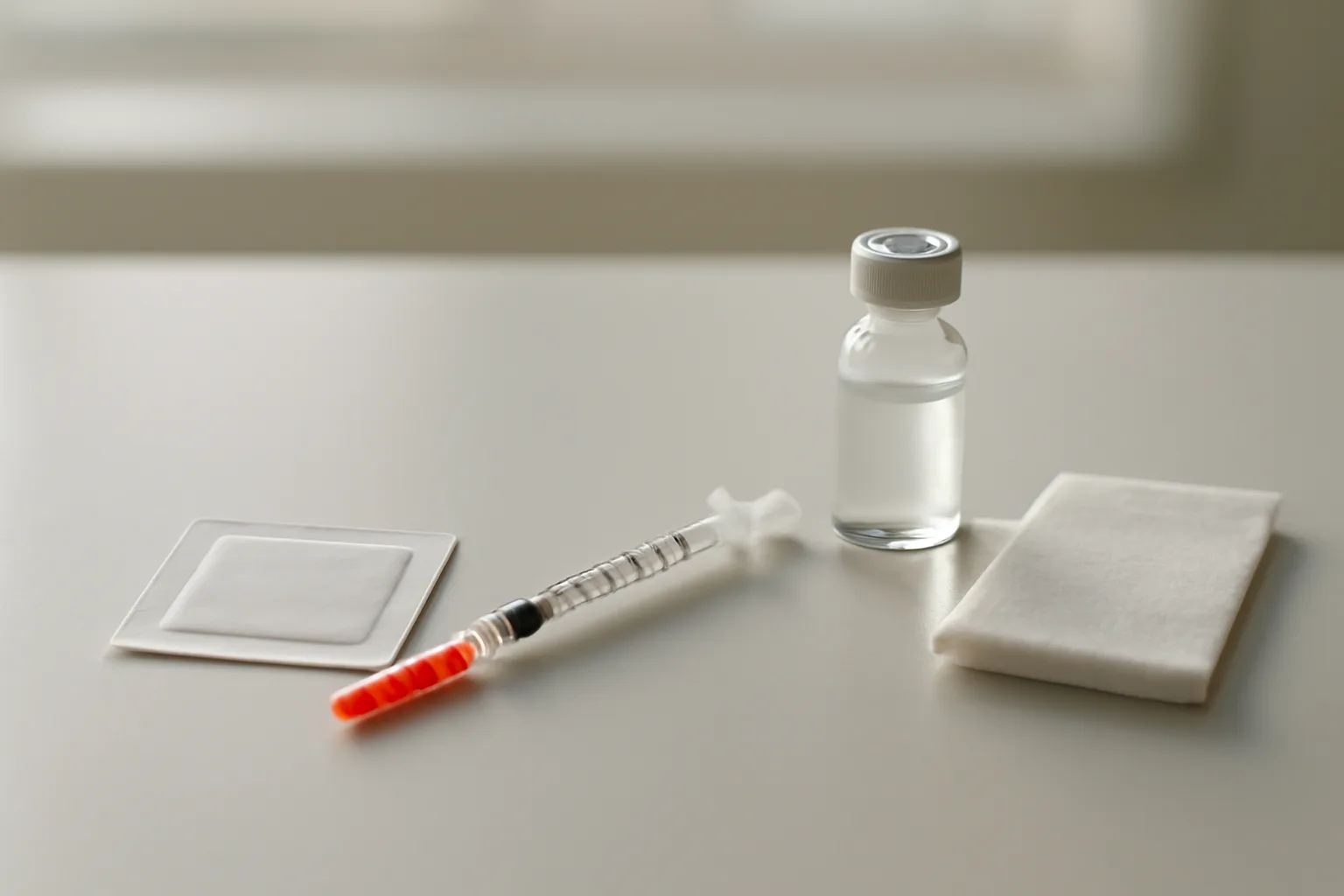
The basic kit: reconstituted AOD-9604 vial, bacteriostatic water (if not pre-mixed), insulin syringes with fixed needles (0.5 mL/50 unit or 1 mL/100 unit, 29-31 gauge is typical for subcutaneous peptide work), alcohol swabs, and a sharps container. Reconstitution matters more than people think. Add the bacteriostatic water slowly, down the side of the vial rather than directly onto the powder, to avoid excess foaming that can denature the peptide. Swirl gently rather than shaking. Once reconstituted, most peptides of this type are stored refrigerated (not frozen) and used within a defined window, generally a few weeks, though exact stability depends on formulation and isn't something we'll invent a number for here since it varies by product and preparation. Check the specific product's guidance rather than assuming a blanket shelf life. Sharps disposal is not optional. Use a rigid, puncture-resistant container and dispose of it according to your local household sharps disposal program; most US municipalities and pharmacies have take-back options.
What dose and injection frequency did the human trials actually use
This is where the marketing usually gets vague, and where it matters most. The obesity trial program behind AOD-9604 (run primarily through Metabolic Pharmaceuticals and later referenced in trial registries and pharmacology literature) tested the compound across a Phase II program, but the topline result was that weight loss did not separate convincingly from placebo across the trial population. The 2004 Current Opinion in Investigational Drugs paper on AOD-9604's metabolic profile is one of the direct sources describing this compound's development as a fat-metabolism-targeted fragment [1], and the 2006 obesity drug pipeline review situates it among other candidates that were, at the time, still in development rather than approved [2]. What this means practically: there is no single, well-replicated, clearly-effective human dose for fat loss that you can point to and say 'this is the regimen that beat placebo by X kg.' Anyone quoting you a precise mg/day protocol as proven is overstating what the trial record supports. If you're going to use it anyway in a research context, that's a decision to make with eyes open about the gap between the fragment's plausible mechanism and its actual trial outcome, not because a specific published dose is known to reliably produce fat loss in humans. For a side-by-side against a peptide with a stronger evidence base and an actual FDA-approved indication, see AOD-9604 vs tesamorelin. Tesamorelin has real placebo-controlled trial data behind an approved use (HIV-associated lipodystrophy); AOD-9604 does not have an equivalent approved indication anywhere.
Where on the body should you inject AOD-9604
For subcutaneous peptide injections generally, the standard sites are the abdomen (avoiding a 2-inch radius around the navel), the outer thigh, and sometimes the back of the upper arm or the love handle area. These are the same sites used for insulin and other daily subcutaneous injections, chosen because they have enough subcutaneous fat and are easy to reach yourself. Abdomen tends to be the easiest self-injection site because you can see what you're doing and pinch a clean fold. Thigh injections work well as a rotation site but can be harder to pinch on leaner individuals. Avoid injecting into scar tissue, moles, stretch marks, or any area that's bruised, swollen, or irritated from a previous injection. If a site is sore or lumpy, skip it and let it recover. There is no evidence that injecting near a specific 'fat pad' target concentrates fat loss there; subcutaneous injection distributes systemically regardless of injection site, so site choice is about comfort, safety, and rotation, not about targeting a body area for localized fat reduction.
Is AOD-9604 safe to inject, and what are the real risks
The most-cited concern with GH-related compounds is that they might affect insulin sensitivity or trigger GH-linked growth effects; the AOD-9604 fragment was specifically engineered to avoid that region of the molecule. A 2004 paper describes this rationale in the metabolic pharmacology literature [1]. A separate practical safety question, relevant to anyone in competitive sport, is whether AOD-9604 would trigger a positive on standard GH doping tests. A 2013 study in Drug Testing and Analysis found that AOD-9604 does not influence the WADA hGH isoform immunoassay [3], meaning it wouldn't show up on that particular screening method the way intact GH would. That doesn't make it approved for use in sport; separate detection methods for small peptides exist and are actively being developed, as covered in a 2014 review of analytical approaches for detecting emerging non-approved drugs in doping controls [4], a 2014 review on detecting peptidic drug candidates in sports doping [5], and a 2016 paper on screening methods for peptides under 2 kDa by direct urine injection and mass spectrometry [6]. Local injection risks are the same as with any subcutaneous peptide: redness, bruising, lipohypertrophy from site overuse, and rare infection if sterile technique isn't followed. There is no large, well-controlled human safety database for AOD-9604 at the doses and durations people are actually using it for outside clinical trials, which is a real gap, not a minor caveat. A 2026 review in the Journal of the American Academy of Orthopaedic Surgeons Global Research & Reviews on therapeutic peptides in orthopaedics discusses AOD-9604 and similar peptides within the broader landscape of peptide therapies facing application and regulatory challenges [7], and a related 2026 Sports Medicine paper on approved versus unapproved peptide therapies for musculoskeletal injuries and athletic performance covers the safety and efficacy picture for this category of compounds [8]. Neither paper is a green light; both frame these peptides as an area still working out its evidence and regulatory footing.
Is AOD-9604 legal to buy and inject in the US
AOD-9604 is not an FDA-approved drug. You can confirm this yourself by searching Drugs@FDA, the FDA's own database of approved drug products [9]; AOD-9604 does not appear there under any approved indication. That matters for how it can legally be sourced. Compounding pharmacies operate under specific FDA rules: 503A pharmacies compound from a defined bulks list under 21 CFR 216.23 [10], and 503B outsourcing facilities work from a separate bulks list under 21 CFR 216.24 [11]. The compounding authority itself comes from 21 U.S.C. 353a [12]. Whether a given peptide can be legally compounded depends on whether it's on FDA's current nominated bulk substances list [13] and how it evaluates under the intended-use framework, and that list changes over time, so check FDA's own current listing rather than trusting a vendor's claim. FDA's own regulation on 'intended use,' 21 CFR 201.128, is also relevant here [14]: how a product is marketed (claims of curing, treating, or preventing a condition) determines its regulatory status regardless of what a label says it's 'for.' A vendor selling AOD-9604 as a 'research chemical' while making fat-loss claims in ad copy is operating in a gray zone that FDA's intended-use framework was written specifically to address. Practically: this is why credible sourcing runs through a provider that discloses what pharmacy is actually fulfilling the product and under what compounding authority, rather than an anonymous research-chemical storefront. AOD-9604 Co's provider-reviewed listings name the fulfilling pharmacy partner for exactly this reason; that's a sourcing transparency question, not a claim that the product's efficacy trial record has changed.
How does AOD-9604 compare to other fat-loss injectable options
| Compound | Approved indication | Human trial outcome for its stated use | Injection frequency |
|---|---|---|---|
| AOD-9604 | None (no FDA-approved use) | Obesity trials did not clearly separate from placebo [1][2] | Reported as daily subcutaneous in research use |
| Tesamorelin | FDA-approved for HIV-associated lipodystrophy | Positive placebo-controlled trial data for its approved indication | Daily subcutaneous |
| Clenbuterol | Not FDA-approved for human fat loss (veterinary bronchodilator elsewhere) | Not tested in modern controlled human fat-loss trials at this scale | Oral, not injected |
The honest comparison here isn't close. Tesamorelin has an actual FDA-approved indication and trial data behind it, even though that indication is lipodystrophy, not general fat loss, and it comes with its own side effect profile and cost. See AOD-9604 vs tesamorelin for the full breakdown of dosing, cost, and what the trials actually measured. Clenbuterol sits in a different risk category entirely: it's a beta-agonist with cardiovascular effects, not a peptide, and isn't injected in typical human fat-loss use. The comparison at AOD-9604 vs clenbuterol covers why these get grouped together in forum discussions despite being pharmacologically unrelated. If you're choosing based on trial strength alone, AOD-9604 is the weakest of the three on that specific metric, because its own obesity trials didn't clear the placebo bar.
How long does an AOD-9604 injection cycle typically run
There's no established, trial-validated cycle length for AOD-9604 fat-loss use, because the trials that would have established one didn't produce a clear win over placebo. Anyone giving you a specific '12-week cycle' as a proven protocol is extrapolating from anecdote or bodybuilding forum convention, not from a published, replicated dosing trial. What the pharmacology literature does establish is the underlying rationale: the 176-191 GH fragment was designed to isolate fat-metabolizing activity from GH's other effects, a rationale covered in the 2004 paper on AOD-9604's metabolic mechanism [1]. That's a plausible mechanism story, not a validated cycle length. If you're going to try it anyway, the more honest approach is short exposure with a defined stop point and clear tracking (weight, waist circumference, injection site condition, any side effects) so you have real data on your own response rather than assuming a protocol works because someone online used it for 12 weeks. The full trial record, including what before-and-after photos circulating online do and don't reflect, is broken down in AOD-9604 before and after claims.
What should you track while injecting AOD-9604
Keep it simple and specific: date, dose, injection site, and any side effects (redness, swelling, GI upset, headache) logged after every injection. Track weight and waist circumference weekly, not daily; day-to-day weight fluctuation from water and food will drown out any real signal, and weekly averages are more honest. If you notice a lump, persistent redness, or a site that's still sore three or more days later, stop using that site and let it fully heal before returning to it. That's a sign of overuse or minor tissue irritation, not something to push through. Without this kind of tracking, you have no way to tell whether any change you see is the compound, your diet, your activity level, or plain regression to the mean, which is exactly the kind of noise that made the original placebo-controlled trials necessary in the first place.
What does the trial evidence gap mean for how you should think about this
The single most important fact in this entire article is one sentence: AOD-9604 went through human obesity trials, and the weight-loss results did not separate convincingly from placebo. That's not a technicality. It's the reason AOD-9604 never became an approved obesity drug despite years of development attention and a plausible mechanism. The 2004 metabolic pharmacology paper [1] and the 2006 obesity pipeline review [2] both document this compound moving through development during the era when it was being actively tested for exactly this use, and it did not emerge the other side as an approved therapy. Good injection technique, careful site rotation, clean reconstitution, and diligent tracking are all things you should do if you're using this compound in a research setting. None of them substitute for the fact that the human efficacy signal for fat loss specifically wasn't there in the trials that tested it. If your primary goal is documented fat-loss results with trial support behind it, the peptide with the actual approved indication and controlled trial data is tesamorelin, not AOD-9604; the full comparison is at AOD-9604 vs tesamorelin. For the detailed trial-by-trial record, including what the actual before-and-after claims circulating online do and don't reflect, read AOD-9604 before and after claims. And if you're weighing it against non-peptide fat-loss compounds people mention in the same breath, AOD-9604 vs clenbuterol covers that ground too.
Frequently asked questions
How do you inject AOD-9604 subcutaneously?
Reconstitute the vial with bacteriostatic water, draw the dose into an insulin syringe (typically 29-31 gauge), pinch a fold of skin at a rotated site (abdomen or thigh most commonly), insert at 45-90 degrees depending on needle length and body fat, inject slowly, then withdraw and apply light pressure. This mirrors standard subcutaneous insulin technique.
What is the best injection site for AOD-9604?
The abdomen (avoiding a 2-inch radius around the navel) and outer thigh are the standard subcutaneous sites, chosen for accessibility and adequate fat layer, not because they target fat loss locally. Rotate between sites to avoid irritation and lipohypertrophy; subcutaneous absorption is systemic regardless of site.
Does AOD-9604 actually cause fat loss in humans?
The human obesity trials behind AOD-9604 did not show weight loss that clearly separated from placebo, despite a plausible fragment-of-GH mechanism described in the pharmacology literature [1][2]. It never reached an FDA-approved obesity indication. Treat fat-loss claims with real skepticism until you've read the actual trial record.
Is AOD-9604 legal to buy in the United States?
AOD-9604 is not FDA-approved and does not appear in the Drugs@FDA database [9]. Whether it can be legally compounded depends on FDA's current bulk substances listings under 21 CFR 216.23 and 216.24 [10][11]; this changes over time, so verify current status rather than trusting a seller's claim.
Will AOD-9604 show up on a drug test?
A 2013 study in Drug Testing and Analysis found AOD-9604 does not influence the WADA hGH isoform immunoassay, the standard screen for intact growth hormone [3]. Separate mass-spectrometry-based methods for detecting small peptides under 2 kDa are actively being developed and could still detect it [4][5][6].
How often do people inject AOD-9604?
Research use commonly describes daily subcutaneous injection, but there is no single published, replicated dosing schedule proven effective for fat loss in the human trial record, since those trials didn't clearly beat placebo. Any specific frequency you see quoted online is convention, not validated protocol.
What gauge needle is used for AOD-9604 injections?
Standard insulin syringes in the 29 to 31 gauge range, typically 0.5 mL (50 unit) or 1 mL (100 unit) barrels, are the common choice for subcutaneous peptide injections of this type. This is consistent with general subcutaneous injection practice rather than something specific to this compound.
How should AOD-9604 be reconstituted?
Add bacteriostatic water slowly down the inside wall of the vial rather than directly onto the lyophilized powder, then swirl gently rather than shaking, to avoid excess foaming that can degrade the peptide. Store the reconstituted vial refrigerated and follow the specific product's stated stability window.
What are the side effects of injecting AOD-9604?
Reported issues are mostly local: redness, bruising, and lipohypertrophy from repeated injection at the same site. There's no large controlled human safety database at real-world research doses and durations, which is a genuine evidence gap, more than a minor caveat, given the trial record on efficacy is already weak.
Is AOD-9604 the same as HGH?
No. AOD-9604 is a synthetic fragment (amino acids 176-191) of the human growth hormone molecule, engineered to isolate the region researchers believed drove fat metabolism while excluding the parts linked to growth and insulin effects [1]. It is not intact growth hormone.
How does AOD-9604 compare to tesamorelin for fat loss?
Tesamorelin has FDA approval for HIV-associated lipodystrophy backed by controlled trial data; AOD-9604 has no approved indication and its obesity trials did not clearly beat placebo. See AOD-9604 vs tesamorelin for the full dosing and evidence comparison.
Can you inject AOD-9604 into the same spot every day?
No. Repeated injection at one site raises the risk of lipohypertrophy (fatty lumps) and irritation, and can make absorption less consistent over time. Standard practice, borrowed from insulin injection technique, rotates between abdomen quadrants and thigh sites on a set schedule.
Where can you find a provider-reviewed source for AOD-9604?
Look for a listing that discloses the actual fulfilling pharmacy and its compounding authority rather than an anonymous research-chemical seller. AOD-9604 Co's provider-reviewed route names the fulfilling pharmacy partner directly, which is the sourcing transparency question, separate from the efficacy question covered in the trial record.
Sources
- PubMed, Current Opinion in Investigational Drugs (2004): AOD-9604 was developed around the fat-metabolizing fragment of the GH molecule, the metabolic pharmacology rationale behind the compound.
- PubMed, Current Opinion in Investigational Drugs (2006): AOD-9604 was listed among obesity drugs in clinical development as of 2006, without an approved obesity indication having been reached.
- PubMed, Drug Testing and Analysis (2013): AOD-9604 does not influence the WADA hGH isoform immunoassay used in standard growth hormone doping screens.
- PubMed, Journal of Pharmaceutical and Biomedical Analysis (2014): Analytical methods for detecting emerging non-approved therapeutic peptides in doping controls are an active area of development.
- PubMed, Expert Review of Proteomics (2014): Detection methods for peptidic drugs and drug candidates in sports doping are covered as a distinct analytical challenge from immunoassay-based GH tests.
- PubMed, Journal of Separation Science (2016): Direct urine injection with liquid chromatography and ion mobility mass spectrometry expands screening for peptides under 2 kDa, a category that includes AOD-9604.
- PubMed, Journal of the American Academy of Orthopaedic Surgeons Global Research & Reviews (2026): Therapeutic peptides including AOD-9604-type compounds face application, safety, and regulatory challenges in orthopaedic and related use contexts.
- PubMed, Sports Medicine (2026): Safety and efficacy of approved versus unapproved peptide therapies for musculoskeletal injuries and athletic performance is an unsettled evidence area covering this compound class.
- FDA, Drugs@FDA database: AOD-9604 does not appear in the FDA's own database of approved drug products.
- eCFR, 21 CFR 216.23 (503A Bulks List): 503A compounding pharmacies operate from a defined bulk drug substances list under this federal regulation.
- eCFR, 21 CFR 216.24 (503B Bulks List): 503B outsourcing facilities compound from a separate bulk substances list under this federal regulation.
- Cornell LII, 21 U.S.C. 353a: Pharmacy compounding authority for substances like AOD-9604 derives from this federal statute.
- FDA, Bulk drug substances nominated for use in compounding (current list): Whether a peptide can be legally compounded depends on its status on FDA's current nominated bulk substances list, which changes over time.
- eCFR, 21 CFR 201.128, meaning of intended uses: FDA's intended-use regulation determines a product's regulatory status based on marketing claims regardless of how it is labeled.