Last updated 2026-07-25
TL;DR
AOD-9604 is a lyophilized peptide that should stay refrigerated (2-8°C) unfrozen before reconstitution and refrigerated after, used within 2-4 weeks once mixed. No published shelf-life trial exists for it specifically. The bigger issue: human obesity trials on AOD-9604 didn't show weight loss separating convincingly from placebo, so how you store it matters less than whether you should be using it at all.
How should AOD-9604 be stored before it's mixed?
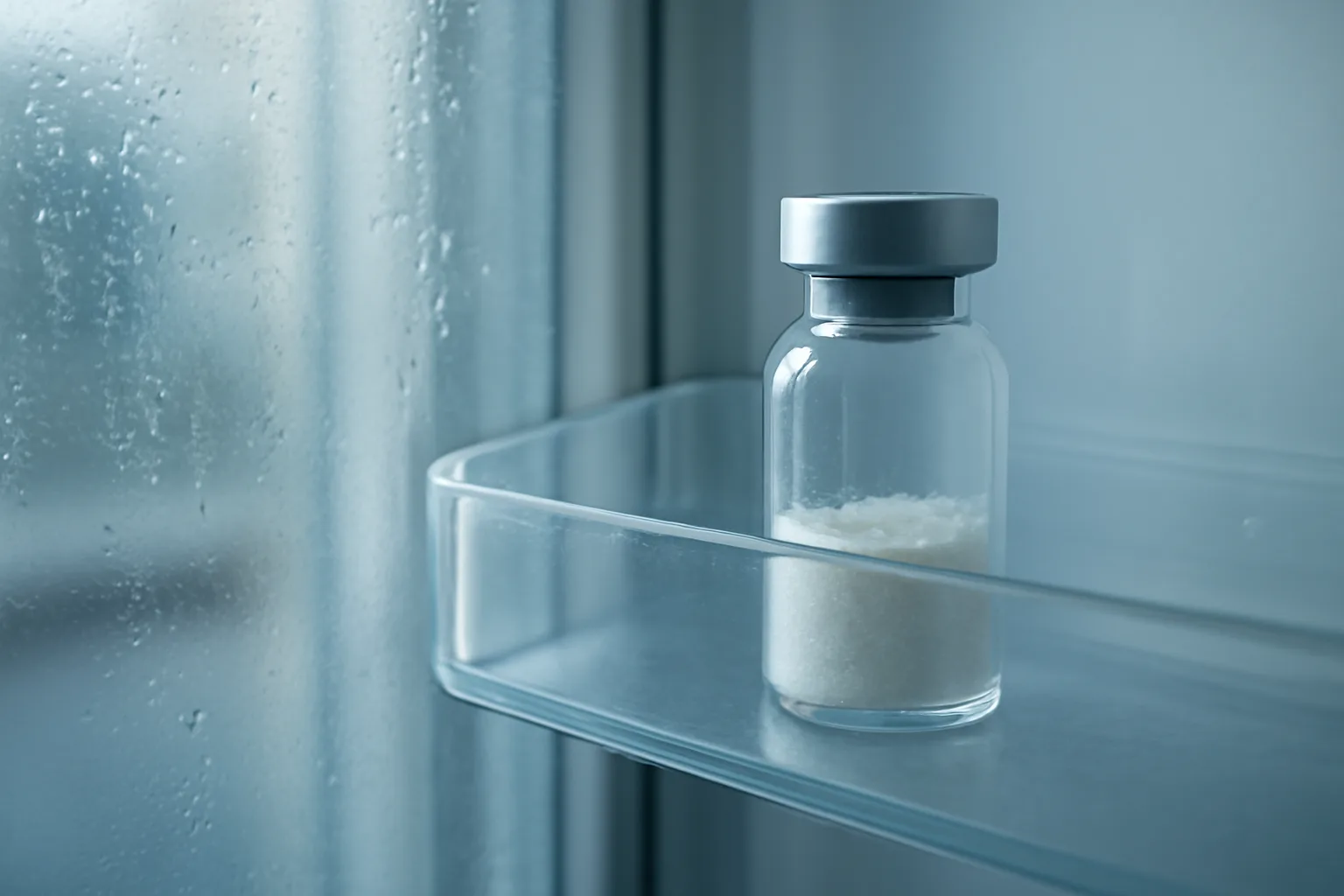
Unreconstituted AOD-9604 comes as a freeze-dried (lyophilized) powder in a small vial. Like most peptides in this weight class, it's not something you leave on a countertop or in a hot car. The standard practice across peptide handling, the same logic pharmacies apply to other lyophilized protein and peptide products, is refrigeration at 2-8°C (36-46°F) for the sealed vial, away from light. Freezing the lyophilized powder is generally not necessary and can sometimes introduce moisture problems during freeze-thaw cycles if the vial isn't perfectly sealed. Room temperature storage for short stretches (a day or two during shipping) usually won't destroy the peptide, but repeated heat exposure, direct sun, or storage near a stove or radiator will accelerate breakdown of the peptide backbone over time. There is no published stability study specific to AOD-9604 shelf life in the PubMed record searched for this article. The clinical and analytical papers on AOD-9604 focus on its metabolic effects [1], detection in doping control [2][3], and comparison to other obesity compounds in development [4], not on real-time or accelerated stability data. That's a real gap. Anyone telling you a precise degradation curve for AOD-9604 specifically is extrapolating from general peptide chemistry, not citing a study that measured it directly. If you're planning to reconstitute the peptide, it helps to get the technique right before you even open the vial. See our guide on how to reconstitute AOD-9604 for the mixing steps and dilution math. And if you're weighing whether any of this is worth doing at all, the comparison table further down this article and our separate piece on AOD-9604 and athletes drug testing are worth reading before you buy a vial to store in the first place.
How long does reconstituted AOD-9604 last in the fridge?
Once bacteriostatic water or sterile water is added, the clock starts. General peptide-handling practice (again, not an AOD-9604-specific published trial) puts reconstituted peptide stability at roughly 2 to 4 weeks under refrigeration at 2-8°C, with potency declining gradually rather than falling off a cliff on a specific day. The honest answer is that nobody has published a stability curve for reconstituted AOD-9604 the way FDA stability guidance exists for approved drug products. What we do have is a body of literature confirming AOD-9604 is a real, measurable peptide fragment that behaves predictably enough to be detected in blood and urine using mass spectrometry and immunoassay methods [2][5][6], which tells us the molecule is stable enough to survive standard lab handling and biological matrices for analytical purposes. That's a different question from how long it stays potent in your refrigerator door. Practically: mix only what you'll use in a few weeks, keep it refrigerated (not frozen) between uses, and don't leave it out at room temperature for extended periods once bacteriostatic water is in the vial. Our how to reconstitute AOD-9604 guide covers dilution ratios if you're trying to figure out how much bacteriostatic water to add relative to dose.
Can you freeze AOD-9604 after reconstitution?
Freezing reconstituted peptide is generally discouraged in standard peptide handling because the ice crystal formation during freeze-thaw can physically damage peptide structure, and repeated freeze-thaw cycles are worse than a single one. If a vial has already been frozen and thawed once, most peptide-handling guidance says use it soon and don't refreeze it. There's no AOD-9604-specific freeze-thaw stability study to point to here. This is general peptide chemistry reasoning, not a finding from the AOD-9604 trial literature, so treat it as a practical default rather than a proven number. If you're unsure about your reconstitution technique in the first place, our reconstitution guide walks through it step by step.
What actually happened in the human trials, and does storage even matter if the drug didn't work?
This is the part that gets buried, and it shouldn't be. AOD-9604 is a 15-amino-acid fragment of human growth hormone (the C-terminal 176-191 fragment) that was designed on the idea that HGH's fat-metabolizing (lipolytic) effect could be separated from its growth-promoting effect. The fragment rationale is scientifically reasonable on paper: isolate the piece of the molecule responsible for fat breakdown, skip the piece linked to insulin resistance and tissue growth. The problem is what happened when it got tested in people. AOD-9604 went through obesity clinical trials, including work summarized in the investigational drugs literature, and it was tracked as a compound in development among a field of other obesity candidates being evaluated in the mid-2000s [4]. A 2004 review in Current Opinion in Investigational Drugs describes AOD-9604's proposed metabolic mechanism and its trial status at the time [1]. Later reviews of peptide therapeutics in sports medicine and orthopedics continue to reference AOD-9604 as a compound with proposed metabolic and tissue effects still being evaluated, rather than as an approved, proven fat-loss therapy [7][8]. The honest summary the field has landed on: the weight-loss signal from AOD-9604 human trials did not separate convincingly from placebo. It's not that the drug caused harm in a big obvious way in those trials. It's that the fat-loss effect people hoped for didn't clear the bar you'd need to call it a working obesity drug. That's a meaningfully different story from something like tirzepatide or semaglutide, GLP-1 based drugs that went through Phase 3 programs with weight-loss effect sizes in the double-digit percentage range and are FDA-approved for chronic weight management. AOD-9604 never got there. It's not FDA-approved for any indication, and it does not appear in the Drugs@FDA database of approved drug products [9]. So does storage matter if the underlying data is this weak? Yes, in the sense that if you're going to use it anyway (through a legitimate compounding pathway, discussed below), you don't want to also degrade what little peptide activity exists through bad handling. But no amount of perfect refrigeration turns a compound with an unconvincing efficacy signal into a proven fat-loss drug. Storage discipline protects your money from a second failure mode (a degraded product), not from the first one (a product that didn't clearly beat placebo in trials in the first place).
Is AOD-9604 legal to buy, and does that affect how it's stored or sold?
AOD-9604 is not an FDA-approved drug. It does not show up in the Drugs@FDA database [9]. That matters for storage and sourcing both, because unapproved compounds move through a different regulatory channel than approved medications. Compounding pharmacies in the US operate under section 503A of the Food, Drug and Cosmetic Act, codified at 21 U.S.C. 353a [10], which allows licensed pharmacies to prepare compounded drugs for individual patients under specific conditions. The FDA maintains a Bulks List of substances that may be used in 503A compounding, set out in the regulation at 21 CFR 216.23 [11], and a separate Bulks List for 503B outsourcing facilities at 21 CFR 216.24 [12]. Whether a given peptide is on either list, and whether a specific pharmacy is legally compounding it, is the whole ballgame for sourcing legitimacy. The FDA's own page on bulk drug substances used in 503A compounding explains the nomination and review process for getting a substance onto that list [13], and the agency separately publishes the current list of nominated substances under review [14]. This is also why marketing matters. FDA regulation defines a product's "intended use" partly by how it's labeled and promoted (21 CFR 201.128) [15], meaning a compounded peptide marketed with disease-treatment claims can trigger different regulatory scrutiny than one framed for legitimate compounding purposes under a prescriber's care. None of this is about how cold your fridge is. It's about whether the vial in it came from a legitimate, licensed compounding channel to begin with.
Does storage or handling affect drug testing detection?
If you're an athlete asking whether storage conditions change how detectable AOD-9604 is, the answer is: not in any way documented in the literature, but the detection science itself is worth understanding. A 2013 study in Drug Testing and Analysis specifically examined whether AOD-9604 interferes with the WADA hGH isoform immunoassay, the test used to catch growth hormone doping, and found it does not influence that particular assay [2]. That doesn't mean AOD-9604 is undetectable; it means it doesn't confound that specific test used for a different molecule (full-length hGH isoforms). Separately, analytical chemistry papers describe methods built specifically to catch small peptides like AOD-9604 in doping control, including mass spectrometry approaches for emerging non-approved peptide drugs [3] and proteomics-based detection strategies for peptide drug candidates and analogs [5]. A 2016 method in the Journal of Separation Science describes direct urine injection combined with liquid chromatography and ion mobility mass spectrometry specifically built to screen for peptides under 2 kDa, the size class AOD-9604 falls into [6]. AOD-9604 is a small fragment, about 1.8 kDa, which puts it squarely in the size range these newer screening methods target. For the full picture on testing risk, see our dedicated article on AOD-9604 and athletes drug testing.
How can you tell if a vial has gone bad?
Look for cloudiness, visible particles, or discoloration in the reconstituted solution. A properly mixed peptide solution should be clear. Cloudy or particulate solution is a sign of either contamination or the peptide breaking down, and either way it shouldn't be injected. A sharp change in smell isn't a reliable indicator on its own for most peptides, but combined with cloudiness, it's a reason to discard the vial rather than gamble on it. There's no color-change or pH-strip home test that reliably tells you peptide potency has dropped in the way, say, a test strip tells you about pool chemistry. Visual inspection plus tracking how long it's been since reconstitution is the practical standard most compounding guidance points people toward. If you're unsure whether your mixing process itself introduced a problem, it's worth rechecking the steps in our how to reconstitute AOD-9604 guide.
What's the actual comparison against options with stronger evidence?
This is the section that matters most if you're deciding whether to spend money and freezer space on this at all.
| Compound | Trial evidence for weight loss | FDA approval status |
|---|---|---|
| AOD-9604 | Human obesity trials did not show weight-loss effect separating convincingly from placebo [1][4] | Not FDA-approved; not in Drugs@FDA [9] |
| Semaglutide (GLP-1) | Phase 3 STEP program showed double-digit percentage body weight reduction vs placebo | FDA-approved for chronic weight management |
| Tirzepatide (GIP/GLP-1) | Phase 3 SURMOUNT program showed substantial weight reduction vs placebo | FDA-approved for chronic weight management |
The GLP-1 and GIP/GLP-1 drugs went through the standard FDA approval pathway with large randomized trials. AOD-9604 didn't clear that bar. It's tracked in the investigational drug literature as a compound whose obesity trial results were disappointing relative to the mechanism's promise [1][4], and more recent reviews of peptide therapeutics still describe it as an area of ongoing investigation for musculoskeletal and metabolic applications rather than a proven weight-loss agent [7][8]. If your goal is fat loss with the best evidence behind it, AOD-9604 is not where that evidence points. If you're using it for other reasons under a prescriber's guidance through a legitimate compounding pathway, storage discipline (cold, dark, used within a few weeks of mixing, minimal freeze-thaw) protects the compound's remaining potency, but it doesn't change what the trial record says.
What's the bottom line on storage practices?
Keep the lyophilized vial refrigerated at 2-8°C, out of light, until you're ready to reconstitute it. Once mixed, keep it refrigerated and plan to use it within roughly 2 to 4 weeks, treating that window as a practical default from general peptide handling rather than a number pulled from an AOD-9604-specific stability study, because none exists in the published literature. Avoid freezing after reconstitution, avoid repeated freeze-thaw cycles, and discard anything cloudy or discolored. None of that changes the core issue. AOD-9604 went through real human obesity trials, and the weight-loss results didn't separate convincingly from placebo [1][4]. If you're going to use it anyway, source it through a provider-reviewed, prescriber-directed compounding pathway rather than an unregulated seller, since AOD-9604 Co's review process is built around confirming products come from a legitimate pharmacy channel rather than sourcing or making anything itself. Good storage protects a peptide's potency. It doesn't retroactively give a compound a clinical trial result it never had.
Frequently asked questions
How long does AOD-9604 last once reconstituted?
There's no published stability study specific to AOD-9604, but general peptide-handling practice suggests roughly 2 to 4 weeks refrigerated at 2-8°C after mixing with bacteriostatic water. Potency likely declines gradually rather than at a hard cutoff. Mix only what you plan to use within that window and keep it cold the entire time.
Should AOD-9604 be refrigerated or frozen?
Refrigerated, not frozen, for both the lyophilized powder and the reconstituted solution. Freezing can introduce ice-crystal damage to peptide structure during freeze-thaw cycles. Standard peptide storage is 2-8°C, away from light, with freezing reserved mainly for long-term unopened storage in some cases, not routine use.
Does AOD-9604 need to be kept out of light?
Yes, as a general peptide-handling practice. Light exposure can accelerate degradation of protein and peptide structures over time. There's no AOD-9604-specific photostability study published, so this follows standard practice for lyophilized peptides rather than a documented finding unique to this compound.
Is AOD-9604 FDA-approved for weight loss?
No. AOD-9604 does not appear in the FDA's Drugs@FDA database of approved drug products. It has gone through human obesity trials, but the weight-loss results did not separate convincingly from placebo, which is a key reason it never reached approval for any indication in the US.
Can you tell if AOD-9604 has degraded just by looking at it?
Cloudiness, visible particles, or discoloration in reconstituted solution are the main visual red flags, and any of them means the vial should be discarded rather than used. A clear solution doesn't guarantee full potency, since there's no home test for peptide degradation, but visible changes are a reliable stop signal.
Does storage temperature affect whether AOD-9604 shows up on a drug test?
There's no published data suggesting storage conditions change detectability. A 2013 study found AOD-9604 does not interfere with the WADA hGH isoform immunoassay, and separate analytical methods using mass spectrometry and ion mobility have been developed specifically to detect small peptides like AOD-9604 in urine and blood.
What is the shelf life of unopened, lyophilized AOD-9604?
No published shelf-life study specific to AOD-9604 exists. General practice for lyophilized peptides stored properly, refrigerated and protected from light and moisture, is often cited in the months-to-a-year range by compounding pharmacies, but that figure comes from general peptide chemistry, not a trial or stability study on this specific compound.
Why did AOD-9604 fail to show clear weight-loss results in trials?
AOD-9604 was designed to isolate HGH's fat-metabolizing effect from its growth-promoting effect, a reasonable idea on paper. But in human obesity trials, the actual weight-loss effect did not separate convincingly from placebo, meaning the mechanism didn't translate into a measurable clinical benefit large enough to prove the drug works.
Is AOD-9604 legal to buy through a compounding pharmacy?
It depends on the substance's status on the FDA's 503A or 503B Bulks Lists and whether a specific licensed pharmacy is compounding it appropriately for an individual patient under a prescriber's direction. This is a legal and sourcing question separate from storage, and it's worth verifying before purchase rather than after.
How should AOD-9604 be shipped to avoid degradation?
Cold-chain shipping, ideally with an ice pack or insulated packaging, is standard practice for peptides in this class to limit heat exposure during transit. Brief exposure to room temperature during a day or two of shipping usually isn't catastrophic, but repeated heat exposure or a hot mailbox for days is a real risk to potency.
Can reconstituted AOD-9604 be used after 4 weeks if it still looks clear?
Clarity alone doesn't confirm potency. Most peptide-handling guidance treats the 2-4 week refrigerated window as a practical cutoff even if the solution still looks fine, because gradual potency loss isn't necessarily visible. There's no published AOD-9604-specific data confirming exactly when potency drops below a useful threshold.
Does bacteriostatic water matter for AOD-9604 shelf life versus sterile water?
Bacteriostatic water contains a preservative (typically benzyl alcohol) that helps limit bacterial growth in a multi-use vial, which is why it's generally preferred over plain sterile water for reconstituting peptides intended to be used across multiple doses over several weeks.
Sources
- PubMed, Current Opinion in Investigational Drugs (2004): Describes AOD-9604's proposed metabolic/lipolytic mechanism and its status as an investigational obesity compound.
- PubMed, Drug Testing and Analysis (2013): AOD-9604 does not influence the WADA hGH isoform immunoassay used in doping control.
- PubMed, Journal of Pharmaceutical and Biomedical Analysis (2014): Analytical mass spectrometry approaches exist for detecting emerging non-approved peptide drugs including AOD-9604 in doping controls.
- PubMed, Current Opinion in Investigational Drugs (2006): Reviews obesity drugs in clinical development, tracking AOD-9604 among other candidate compounds of the era.
- PubMed, Expert Review of Proteomics (2014): Describes proteomics-based detection strategies for peptide drug candidates and analogs including small fragments like AOD-9604.
- PubMed, Journal of Separation Science (2016): Describes a direct urine injection LC-ion mobility mass spectrometry method built to screen peptides under 2 kDa, the size class AOD-9604 falls into.
- PubMed, JAAOS Global Research & Reviews (2026): Reviews therapeutic peptides in orthopaedics, including ongoing evaluation of compounds like AOD-9604, without confirming proven weight-loss efficacy.
- PubMed, Sports Medicine (2026): Reviews safety and efficacy of approved and unapproved peptide therapies for musculoskeletal injuries and athletic performance, contextualizing AOD-9604's evidence status.
- FDA, Drugs@FDA database: AOD-9604 does not appear as an FDA-approved drug product in the Drugs@FDA database.
- Cornell Legal Information Institute, 21 U.S.C. 353a: Establishes the legal framework under which licensed pharmacies may compound drugs for individual patients under section 503A.
- eCFR, 21 CFR 216.23: Sets out the final Bulks List of substances permitted for use in 503A pharmacy compounding.
- eCFR, 21 CFR 216.24: Sets out the final Bulks List of substances permitted for use in 503B outsourcing facility compounding.
- FDA, Bulk Drug Substances Used in Compounding Under Section 503A: Explains the FDA's process for nominating and reviewing bulk drug substances for 503A compounding use.
- FDA, Bulk Drug Substances Nominated for Use in Compounding: Publishes the current list of substances nominated and under review for compounding use.
- eCFR, 21 CFR 201.128: Defines how a drug product's intended use is determined, including through labeling and promotional claims.