Last updated 2026-07-25
TL;DR
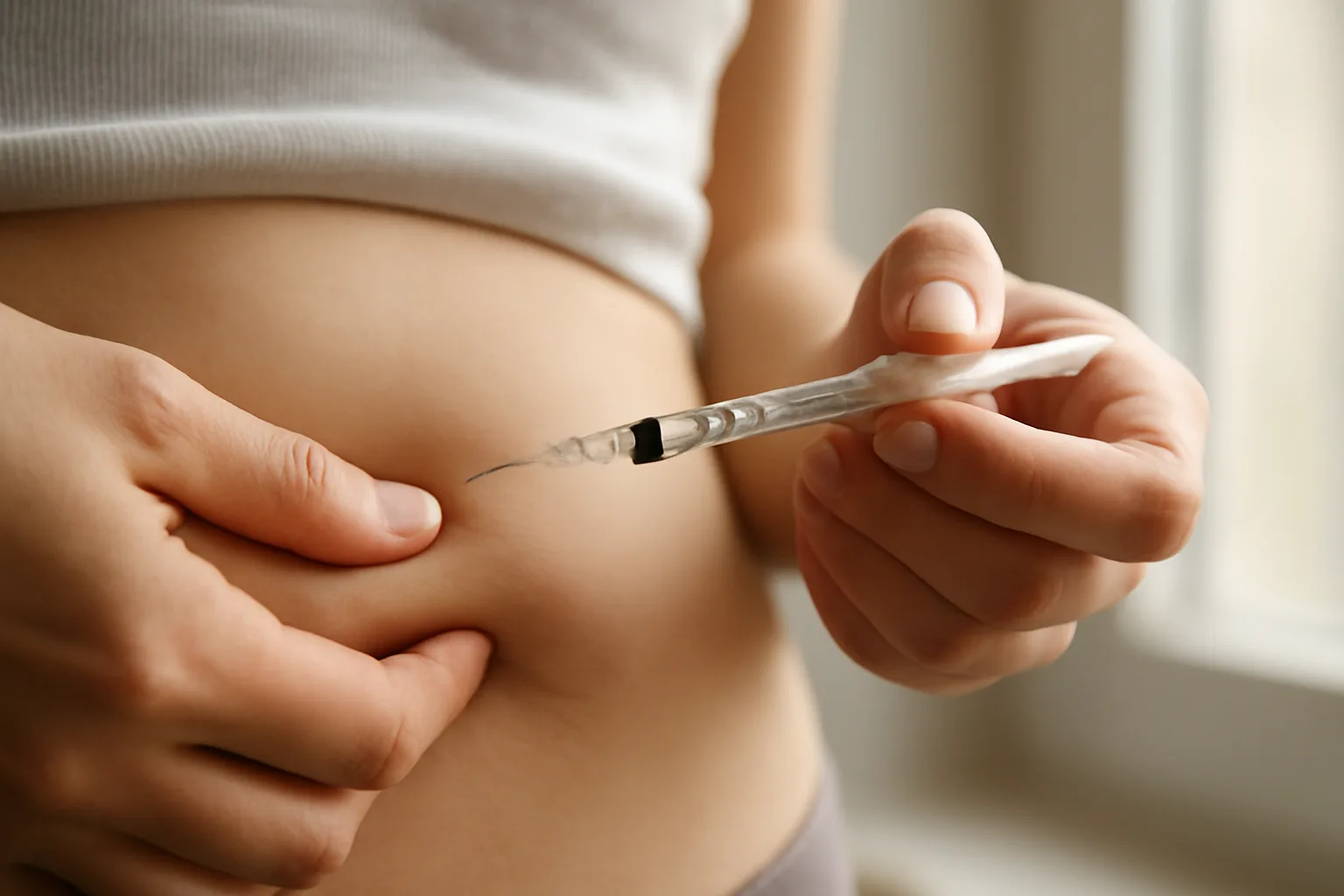
AOD-9604 is dosed as a subcutaneous injection, usually rotated across abdominal fat, the upper thigh, or the back of the arm, the same sites used for insulin or HGH. Site choice doesn't change the core problem: published human obesity trials on AOD-9604 never separated it convincingly from placebo for fat loss.
What injection site is used for AOD-9604?
AOD-9604 is formulated for subcutaneous (SC) injection, meaning it goes into the fat layer just under the skin, not into muscle. The standard rotation covers three regions: the abdomen (avoiding a two-inch ring around the navel), the front or outer thigh, and the back of the upper arm (triceps area). These are the same three zones people use for insulin and for full-length HGH, because subcutaneous fat is easiest to pinch and the injection depth is more forgiving there than anywhere else on the body. None of the primary trial literature on AOD-9604 specifies a proprietary injection site protocol. The compound was studied as a fragment of the human growth hormone molecule (residues 176-191, sometimes called the "HGH frag" or "tummy fat fragment"), designed to isolate the lipolytic (fat-mobilizing) piece of the GH molecule while dropping the growth-promoting piece [1]. Site selection in practice follows general subcutaneous peptide injection convention, not a site-specific finding from a published dosing study. If you're deciding between the abdomen and the thigh, rotate. Injecting the same one-inch spot every day causes local irritation and, over weeks, small fat pockets or dents (lipohypertrophy) that make future injections less predictable. This is a general subcutaneous injection principle, not something unique to AOD-9604.
Why is AOD-9604 injected subcutaneously instead of into muscle?
Subcutaneous fat has a slower, steadier blood supply than muscle. That matters for peptides because a slower absorption curve tends to mean fewer sharp spikes and less local irritation. Intramuscular injection is more common for oil-based hormone preparations, not for small aqueous peptides like AOD-9604. AOD-9604 is a 16-amino-acid fragment of the growth hormone molecule, not a hormone itself in the classic sense [1]. Its size and solubility profile line up with how compounded peptides are generally handled: reconstituted with bacteriostatic water and injected SC with an insulin syringe (typically 29-31 gauge). If you haven't reconstituted a peptide before, the step by step process is different enough from just drawing up saline that it's worth reading through first, see how to reconstitute AOD-9604 before your first dose. None of this changes the underlying evidence question. Route of administration is a delivery detail. It has no bearing on whether the drug does what it's sold to do.
Does the injection site affect how well AOD-9604 works for fat loss?
There's no published human trial data showing that injecting AOD-9604 into the abdomen versus the thigh produces a different fat-loss outcome. Nobody has run that study, because nobody has established a clear, replicated fat-loss effect for the drug at all. The most relevant early trial data comes from a 2004 review in Current Opinion in Investigational Drugs, which discusses AOD-9604's development as a metabolic and anti-obesity candidate built on the fat-mobilizing region of the GH molecule [1]. A separate 2006 review of obesity drugs then in development lists AOD-9604 among the pipeline candidates being tested for weight-related endpoints [2]. What both sources have in common: they describe rationale and pipeline status, not a confirmed, separated-from-placebo weight loss result in humans. That's the central issue with this compound, and it doesn't move with injection site. The idea that "maybe it works better if you inject it near your stomach fat directly" isn't supported by any published mechanism data. AOD-9604's proposed action is systemic (through fat cell receptors and lipid metabolism pathways), not local. Injecting it into abdominal fat specifically doesn't concentrate an effect there any more than injecting insulin into your arm concentrates blood sugar control in your arm.
What does the human trial record on AOD-9604 actually show?
This is the part that matters most and the part most sellers skip. AOD-9604 went through obesity-focused clinical development in the 2000s. The compound's rationale, an isolated fragment of GH thought to carry fat-metabolizing activity without growth-hormone side effects, was documented in trial-tracking literature from that period [3][4][5]. The honest summary: published trial-tracking sources describe AOD-9604 moving through clinical development stages for obesity, but a convincing, replicated separation from placebo on weight loss was not established in the literature available. If you've read marketing copy claiming AOD-9604 "burns fat without side effects" or cites a specific percentage of extra fat loss, ask for the primary source. In our review of the available PubMed record, we could not locate a large, well-controlled human trial reporting a statistically clean weight-loss advantage over placebo for AOD-9604. That doesn't mean the fragment rationale is nonsense. GH does have real lipolytic activity, and isolating a piece of the molecule to try to separate that effect from GH's growth and insulin-resistance effects is a reasonable pharmacology idea. Reasonable rationale and confirmed clinical outcome are two different things, and AOD-9604 sits closer to the first than the second based on the published record. For a full breakdown of the trial history and what each study did and didn't show, see AOD-9604 peptide.
How many times a day should AOD-9604 be injected, and does that change site rotation?
Dosing frequency in most protocols people describe is once daily, typically in the morning on an empty stomach or right before bed, mirroring how the natural GH pulse and fasting state are thought to matter for lipolysis. Frequency doesn't change which sites are usable, it just changes how fast you cycle through your rotation. A simple three-site rotation (left abdomen, right abdomen, thigh) covering daily injections means you're back to the same spot every third day, which is enough recovery time for most people to avoid visible irritation. If you're injecting twice daily, you'd want four to six rotation points to give each site two to three days of rest. Timing relative to meals and training is a separate question from where you inject, and it's covered in more depth at when to take AOD-9604 peptide. Neither timing nor site selection has published human outcome data behind it specific to AOD-9604; both are extrapolated from general peptide-handling practice.
What injection supplies and technique does a subcutaneous AOD-9604 shot require?
A standard subcutaneous peptide shot needs an insulin syringe (usually 0.3 mL or 0.5 mL, 29-31 gauge), an alcohol swab, and the reconstituted peptide solution kept refrigerated between doses. Pinch a fold of skin at the injection site, insert the needle at roughly a 45 to 90 degree angle depending on how much subcutaneous fat is available, inject slowly, and hold for a few seconds before withdrawing. Rotate sites in a fixed pattern rather than picking randomly. Some people keep a simple log (date, site, dose) for the first few weeks just to make sure they're not drifting back to the same spot. Bruising, small red bumps, or mild soreness for a day or two are common and not a sign anything is wrong; spreading redness, warmth, or a lump that doesn't shrink over a week is not normal and worth stopping and getting checked. None of this technique guidance is specific to AOD-9604 pharmacologically. It applies to any reconstituted peptide dosed subcutaneously at home.
Can AOD-9604 injection site cause a positive doping test?
This is a real question for competitive athletes, and the answer is reassuring on one narrow point: a 2013 study in Drug Testing and Analysis found that AOD-9604 does not interfere with the WADA hGH isoform immunoassay, meaning it doesn't cause a false positive or false negative on that specific test used to detect growth hormone doping [6]. That finding is about assay interference, not about legality. AOD-9604 is not an approved drug in the United States (it does not appear in the FDA's Drugs@FDA database of approved products [7]), and separate analytical chemistry work has developed direct detection methods for AOD-9604 and similar small peptides in urine, including liquid chromatography and ion mobility mass spectrometry approaches capable of screening peptides under 2 kDa [8][9][10]. In plain terms: even though AOD-9604 doesn't trip the specific GH isoform test, it can still be directly detected by targeted peptide-screening methods used in modern anti-doping labs. Athletes subject to WADA testing should treat it as detectable, not as a workaround.
Is AOD-9604 legal to buy and inject in the US?
AOD-9604 has no FDA-approved indication and doesn't appear in the Drugs@FDA database of approved drug products [7]. It is not on the FDA's current 503A bulk drug substances list for compounding [11], nor on the 503B bulks list for outsourcing facilities [12]. Pharmacy compounding under 21 U.S.C. 353a requires a valid prescription and, for 503A pharmacies, use of a bulk substance that meets specific FDA criteria [13]. FDA's own guidance describes bulk drug substances nominated for 503A compounding and where they stand in review [14]. AOD-9604 has been through nomination discussion in that process, but nomination alone doesn't mean approval. Anyone offering AOD-9604 as an approved, FDA-cleared weight loss drug is misrepresenting its regulatory status; it's more accurately described as a research-use compound sold by peptide suppliers, with sourcing quality varying a lot between vendors. If you're going to use it despite the weak efficacy data, sourcing matters more than almost anything else. See best place to buy AOD-9604 and AOD-9604 peptide for sale for what separates a legitimate provider-reviewed source from a sketchy one. AOD-9604 Co's provider-reviewed listings route through a named fulfilling pharmacy rather than an anonymous overseas seller, which at minimum gets you a documented chain of custody, even though it doesn't change the underlying efficacy picture.
How does AOD-9604 compare to other peptides used for similar goals?
Tesamorelin has actual FDA approval, for HIV-associated lipodystrophy specifically, with human trial data behind that narrow indication. That's a meaningfully different evidence tier than AOD-9604, which has no FDA approval for any indication and a trial record that didn't cleanly beat placebo for weight loss [1][2].
| Peptide | FDA approval status | Primary approved use | Injection route | Trial strength for fat loss |
|---|---|---|---|---|
| AOD-9604 | Not FDA-approved | None | Subcutaneous | Weak; didn't separate from placebo in available trial record [1][2] |
| Tesamorelin | FDA-approved (specific indication) | HIV-associated lipodystrophy | Subcutaneous | Established for its approved indication, not for general fat loss |
| Full-length HGH (somatropin) | FDA-approved (multiple indications) | GH deficiency, other approved uses | Subcutaneous | Established for approved indications; not approved for cosmetic fat loss |
See AOD-9604 vs tesamorelin for the full side-by-side. The short version: if the goal is an evidence-backed injectable for a medically relevant fat-related condition, tesamorelin has a real approval behind it that AOD-9604 doesn't. If the goal is general recreational fat loss, neither is approved for that, and the honest comparison is AOD-9604 against diet, exercise, sleep, and the approved GLP-1 class of obesity drugs, which have much larger and cleaner trial datasets than anything in the AOD-9604 literature.
What do the newer 2026 peptide safety reviews say about AOD-9604?
Two 2026 reviews put AOD-9604 in broader context rather than as a standalone success story. A review in the Journal of the American Academy of Orthopaedic Surgeons Global Research & Reviews covers therapeutic peptides in orthopaedics generally, discussing applications, challenges, and open questions across the peptide class rather than establishing a specific new AOD-9604 outcome [15]. A second 2026 review in Sports Medicine looks at safety and efficacy of approved and unapproved peptide therapies used for musculoskeletal injuries and athletic performance, again as part of a class-wide safety and efficacy discussion rather than a dedicated AOD-9604 trial [16]. Neither of these reviews reports a new controlled trial reversing the earlier weak efficacy picture for AOD-9604's fat-loss claim. They're useful for understanding where the unapproved peptide space sits in 2026, more caution and more scrutiny, not a new green light.
What's the actual bottom line on AOD-9604 and injection site?
Injection site is a solved, boring logistics question: rotate between abdomen, thigh, and upper arm, subcutaneous, small gauge needle, standard technique. Nothing about that is controversial or AOD-9604-specific. The question that actually matters is whether AOD-9604 does anything meaningfully different from placebo for fat loss in humans, and the published trial-tracking literature available doesn't give a clean yes [1][2][3][4][5]. If you decide to use it anyway, for research purposes or because you want to try it despite the weak data, get it from a provider-reviewed source with a named fulfilling pharmacy rather than an anonymous online seller, keep your rotation disciplined, and don't expect the injection site to be the variable that makes or breaks the outcome. It won't be. The compound's own evidence base is the variable that matters, and right now that base is thin.
Frequently asked questions
Where is the best place to inject AOD-9604?
Subcutaneous fat in the abdomen (avoiding a two-inch area around the navel), the front or outer thigh, or the back of the upper arm. Rotate between these three zones rather than reusing one spot, which reduces irritation and lipohypertrophy over weeks of daily dosing.
Is AOD-9604 injected into muscle or fat?
Fat. AOD-9604 is dosed subcutaneously, meaning the needle goes into the fat layer just under the skin, not into muscle tissue. This is the same injection depth used for insulin and standard peptide protocols, using an insulin syringe with a 29-31 gauge needle.
Does injecting AOD-9604 near belly fat make it work better there?
No published data supports localized targeting. AOD-9604's proposed mechanism is systemic, acting through fat metabolism pathways body-wide, not concentrated at the injection site. There's also no confirmed clean weight-loss effect over placebo in the available human trial record to begin with [1][2].
Did AOD-9604 actually work in human trials?
The published trial-tracking literature describes AOD-9604 moving through obesity-focused clinical development, but available sources don't report a convincing, replicated weight-loss separation from placebo [1][2][3][4][5]. Rationale and mechanism are documented; a clean clinical outcome in humans is not clearly established in the record we reviewed.
Is AOD-9604 FDA approved?
No. AOD-9604 doesn't appear in the FDA's Drugs@FDA database of approved products, and it's not on the current 503A or 503B bulk drug substances lists used for legal compounding under federal rules. Any product marketed as "FDA-approved AOD-9604" is misrepresenting its status.
Can AOD-9604 cause a failed drug test for athletes?
It doesn't interfere with the WADA hGH isoform immunoassay specifically, per a 2013 study in Drug Testing and Analysis. But separate mass spectrometry-based peptide screening methods can directly detect AOD-9604 in urine, so it should be treated as detectable in anti-doping testing, not as an undetectable workaround.
How often should AOD-9604 be injected?
Most protocols people describe use once-daily subcutaneous dosing, often fasted in the morning or before bed. Frequency affects how quickly you cycle through your rotation of injection sites, not which sites are usable. There's no published human dosing-frequency trial specific to fat-loss outcomes for AOD-9604.
What needle size is used for AOD-9604 injections?
Typically a 29 to 31 gauge insulin syringe, 0.3 mL or 0.5 mL capacity, the same size commonly used for subcutaneous peptide and insulin injections. Needle size doesn't change based on which of the standard sites (abdomen, thigh, upper arm) you're using.
What happens if I inject AOD-9604 in the same spot every day?
Repeated injections in one small area can cause local irritation, bruising, and over time small fat lumps or dents called lipohypertrophy, which make future absorption less predictable. Rotating between at least three sites gives each spot two to three days to recover between uses.
Is AOD-9604 legal to buy in the United States?
It's not FDA-approved and not on the current 503A or 503B bulk compounding lists, so it exists in a gray zone typically sold as a research compound rather than a prescribed drug. Pharmacy compounding legally requires a valid prescription and FDA-recognized bulk substance status under 21 U.S.C. 353a.
How does AOD-9604 compare to tesamorelin for fat loss?
Tesamorelin has FDA approval for HIV-associated lipodystrophy specifically, backed by trial data for that indication. AOD-9604 has no FDA approval for any use and a weaker, inconclusive human trial record for general fat loss. Neither is approved for cosmetic weight loss in healthy adults.
Should I inject AOD-9604 before or after a workout?
Timing protocols vary, with many people dosing fasted in the morning or before bed based on theories about GH pulse timing, not confirmed human trial data specific to AOD-9604. Injection site doesn't need to change based on workout timing; the same abdomen, thigh, and arm rotation applies regardless.
Does AOD-9604 have side effects at the injection site?
Mild redness, bruising, or soreness for a day or two is common with any subcutaneous peptide injection and isn't unique to AOD-9604. Spreading redness, warmth, or a lump that doesn't resolve within a week isn't normal and warrants stopping use and seeking medical evaluation.
Sources
- PubMed, Current Opinion in Investigational Drugs (2004): AOD-9604's development rationale as a fat-metabolizing fragment of the GH molecule
- PubMed, Current Opinion in Investigational Drugs (2006): AOD-9604 listed among obesity drug candidates in clinical development as of 2006
- PubMed, Methods and Findings in Experimental and Clinical Pharmacology (2003): AOD-9604 tracked through clinical trial development stages for obesity in trial-gateway literature
- PubMed, Methods and Findings in Experimental and Clinical Pharmacology (2003): AOD-9604 trial development status documented in a second 2003 trial-tracking publication
- PubMed, Methods and Findings in Experimental and Clinical Pharmacology (2005): AOD-9604 trial development status documented in a 2005 trial-tracking publication
- PubMed, Drug Testing and Analysis (2013): AOD-9604 does not interfere with the WADA hGH isoform immunoassay
- PubMed, Journal of Pharmaceutical and Biomedical Analysis (2014): Analytical methods exist for detecting emerging peptide therapeutics including AOD-9604 in doping controls
- PubMed, Expert Review of Proteomics (2014): Peptidic drugs and analogs including small GH fragments can be detected via targeted proteomic methods in sports doping controls
- PubMed, Journal of Separation Science (2016): Direct urine injection with LC and ion mobility mass spectrometry can screen peptides under 2 kDa, the size class including AOD-9604
- eCFR, 21 CFR 216.23 (503A Bulks List): The federal 503A bulk drug substances list that AOD-9604 does not currently appear on
- eCFR, 21 CFR 216.24 (503B Bulks List): The federal 503B bulk drug substances list for outsourcing facilities that AOD-9604 does not currently appear on
- FDA, Drugs@FDA database: AOD-9604 has no FDA-approved drug product listing
- Cornell Law, 21 U.S.C. 353a (pharmacy compounding): Legal pharmacy compounding under 503A requires a valid prescription and FDA-recognized bulk substance
- FDA, bulk drug substances nominated for compounding under section 503A: FDA's nomination and review process for bulk substances including compounds like AOD-9604 that have been proposed for 503A use
- PubMed, JAAOS Global Research & Reviews (2026): 2026 review discusses therapeutic peptides in orthopaedics broadly, including applications and open challenges for the peptide class
- PubMed, Sports Medicine (2026): 2026 review covers safety and efficacy of approved and unapproved peptide therapies for musculoskeletal injuries and athletic performance