Last updated 2026-07-24
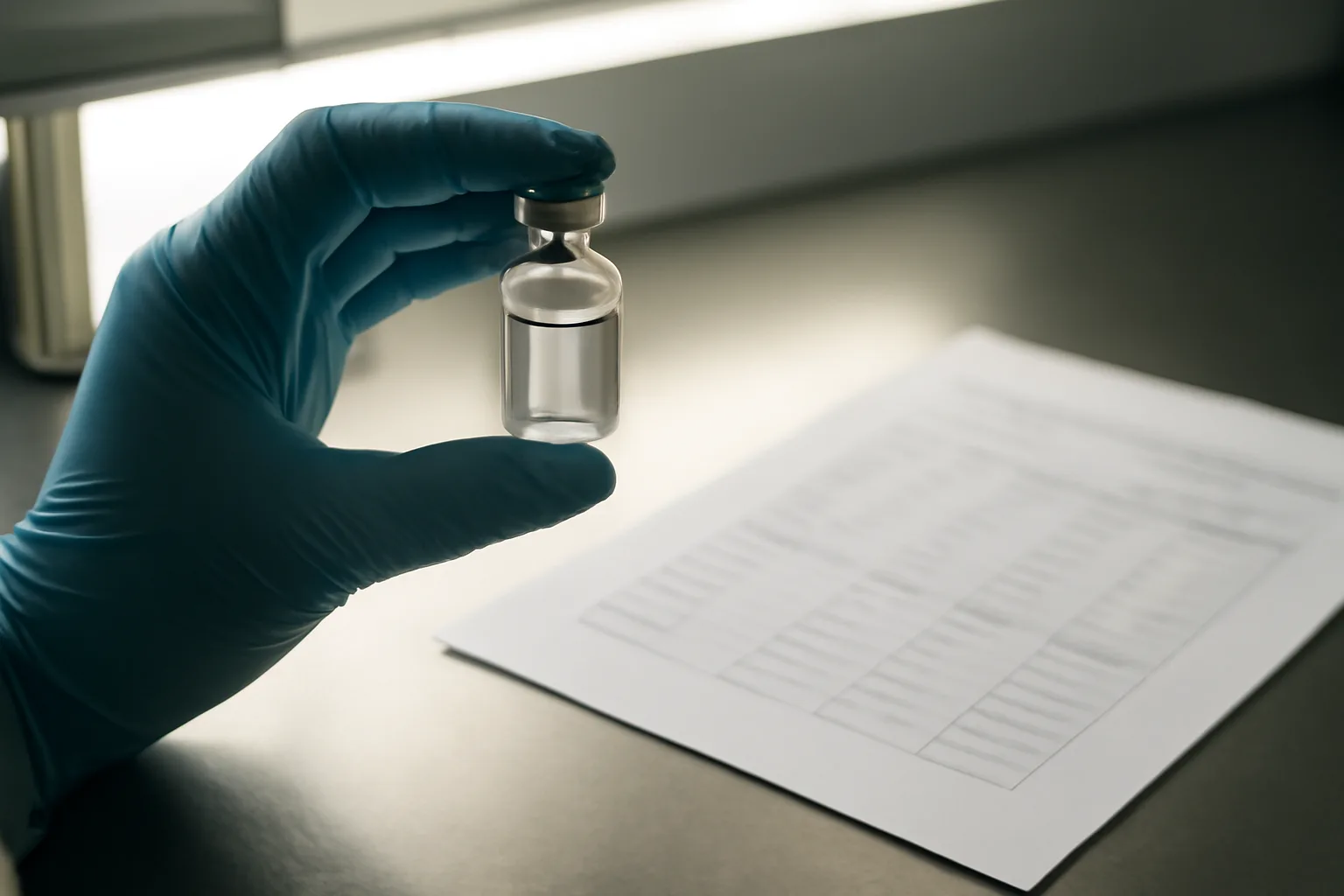
TL;DR
There's no consumer lab test that proves an AOD-9604 vial is what the label says. The realistic path is checking the seller's paperwork (COA with the right test method and batch number), the bulk-substance legal status, and being honest that the human obesity trial data behind AOD-9604 never separated convincingly from placebo. Verify the seller and the science together, more than one.
What does 'verifying quality' even mean for a peptide like AOD-9604?
For a compound like this, quality verification really covers three separate questions, and people usually conflate them into one. First: is the vial actually AOD-9604 and not something else, or nothing at all? Second: is it pure enough and free of contaminants? Third: does the underlying science justify buying it in the first place? Most buyer guides only answer the first two, and even then usually badly, because home testing for a 5 kDa peptide fragment is not something an individual can do without a mass spectrometer. What you're actually doing when you "verify quality" is verifying the seller's documentation and their consistency, not the molecule itself. That's a meaningfully different task, and worth being honest about upfront. The third question is the one most sourcing guides skip entirely, and it's the one that matters most. AOD-9604 is a fragment of human growth hormone (amino acids 176-191, the region researchers linked to fat metabolism without the growth-promoting effects of full HGH). It went through actual human obesity trials. The results did not show a clean, convincing separation from placebo. If you're verifying "quality," the paperwork on the vial is the smaller half of the problem. The bigger half is whether the product does what it's sold to do at all.
Did AOD-9604 actually work in human trials?
This is the part sourcing pages tend to bury, and it shouldn't be buried. A 2004 review in Current Opinion in Investigational Drugs covering AOD-9604's development described it as a fragment of hGH (amino acids 176-191) developed specifically to isolate the fat-metabolizing activity of growth hormone from its growth-promoting and diabetogenic effects [1]. That was the pharmacological rationale, and it's a genuinely reasonable one on paper: hGH does mobilize fat, and if you could get the lipolytic effect without the insulin resistance and tissue growth side effects, you'd have something useful. A 2006 review of obesity drugs in clinical development covered AOD-9604 among a class of candidate anti-obesity compounds moving through trial pipelines at the time [2]. The compound did reach Phase II/III human obesity trials run by its original developer, Metabolic Pharmaceuticals, in Australia in the mid-2000s. Here's the honest summary: the weight-loss effect size in those human trials did not separate convincingly from placebo. That's not a matter of dosing it wrong or buying bad product. That's what the actual clinical program showed. The compound never received FDA approval for obesity or any other indication, and it does not appear in the FDA's Drugs@FDA database of approved products [3]. Nothing sold today as "AOD-9604" is an approved drug. It's sold as a research chemical, and any weight-loss framing beyond that is marketing, not clinical fact. If you're weighing whether to buy at all, read the full trial history first: aod 9604 peptide.
How can I check a vial actually contains AOD-9604 and not something else?
You can't, not with home tools. Confirming peptide identity requires mass spectrometry or a comparable analytical method run in a lab, not a test strip or a color reaction you can do in a kitchen. What you can do is check whether the seller is providing evidence consistent with a real, tested batch, and treat the absence of that evidence as disqualifying. A legitimate Certificate of Analysis (COA) should specify: the analytical method used (typically HPLC for purity, mass spec for identity), the batch or lot number matching what's printed on your vial, the date of testing, and the name of the testing lab (ideally third-party, not the seller's in-house lab). If a COA is a generic PDF with no batch number tying it to your specific vial, it's worthless as evidence, even if the chemistry described in it looks fine. Academic reviews of doping-control methods show what real analytical verification of peptides like AOD-9604 actually requires: liquid chromatography combined with mass spectrometry, sometimes paired with ion mobility separation to resolve small peptides under 2 kDa from other urinary or matrix components [4]. That's laboratory infrastructure, not something a buyer replicates at home. The takeaway isn't that verification is impossible. It's that verification happens at the seller and lab level, and you're auditing their paperwork, not testing the vial yourself.
Is AOD-9604 legal to buy and sell in the US?
This is the sourcing question that actually has clear documentation behind it, unlike the efficacy question. AOD-9604 is not FDA-approved for any use in humans. It doesn't appear on either of the FDA's lists of bulk drug substances that compounding pharmacies are permitted to use. Under federal law, pharmacies compounding human drugs under Section 503A of the Food, Drug and Cosmetic Act may only use bulk drug substances that meet specific criteria, including substances on FDA's 503A Bulks List [5][6]. A separate list under 21 CFR 216.24 governs outsourcing facilities registered under Section 503B . AOD-9604 is not on the current 503A list [7], and FDA's own public list of substances nominated for compounding consideration is the place to check current status, not a seller's marketing page [8]. What that means practically: any AOD-9604 sold in the US is sold as "research use only," not for human consumption, and it is not being lawfully compounded into a prescription product for you at a pharmacy. Sellers who imply otherwise, or who market it with dosing instructions for personal use, are misrepresenting its regulatory status. Under 21 CFR 201.128, the intended use of a drug is determined by how it's labeled, advertised, and represented, more than what the label technically says . A "research use only" vial marketed with human dosing charts and weight-loss claims sits in a legal gray zone that regulators, not buyers, get to interpret.
What should a legitimate seller's paperwork actually include?
Documentation buyers should demand, at minimum: - A COA with a matching batch number, the testing method (HPLC purity, MS identity), and a named third-party lab, more than an in-house report
- Clear "research use only" labeling, not human dosing marketing dressed up around a research disclaimer
- No claims of FDA approval or clinical indication, since none exists in Drugs@FDA [3]
- A visible batch or lot number on the vial itself, matching the COA on file
- Storage and handling information consistent with a lyophilized peptide (typically refrigerated or frozen until reconstitution) If a seller can't produce a batch-matched COA on request, that's the single clearest red flag available to an ordinary buyer. It doesn't prove contamination or mislabeling, but it removes the only piece of evidence you had access to. Sellers who resist a straightforward request for batch-specific paperwork are telling you something. For guidance on handling and reconstituting a legitimate research vial once you've cleared the sourcing question, see aod 9604 how to reconstitute.
Why does the fragment rationale sound convincing even though the trials didn't confirm it?
The biology behind AOD-9604 is coherent, and that's exactly why the marketing around it is persuasive. Full-length human growth hormone does two things at once: it promotes lipolysis (fat breakdown) and it drives tissue growth and can worsen insulin sensitivity. The AOD-9604 fragment, spanning amino acids 176-191 of hGH, was designed to isolate the lipolytic region without carrying the growth-hormone receptor binding that causes the side effects [1]. That's a legitimate and well-reasoned drug design strategy. Fragment-based approaches to reducing side effects while preserving a target effect are common in pharmacology, and this one isn't fringe science. The problem is the step from plausible mechanism to human outcome. Plenty of compounds with clean mechanistic stories fail to produce a measurable clinical effect once tested in real people at real doses over real timeframes. That's what appears to have happened here: the mechanism held up better than the outcome did. A recent review on peptide use in orthopaedic and musculoskeletal contexts notes AOD-9604 among peptides discussed for potential applications and open questions in that space, distinct from its original obesity indication [2]. A 2026 Sports Medicine review covering safety and efficacy of approved and unapproved peptide therapies for musculoskeletal and athletic performance use likewise discusses AOD-9604 within the broader unapproved-peptide category, not as an established therapy with confirmed outcomes [9]. Neither of these repositions AOD-9604 as a proven fat-loss agent; they reflect ongoing interest in the fragment across different research contexts, which is not the same thing as clinical confirmation.
Does AOD-9604 show up on a doping test, and does that matter for quality verification?
It matters less for personal fat-loss buyers and more for anyone competing under WADA rules, but it's a data point people ask about, so it's worth being precise. A 2013 study in Drug Testing and Analysis found that AOD-9604 does not influence the WADA hGH isoform immunoassay, meaning it doesn't trigger a positive on the standard test used to detect growth hormone doping [10]. That doesn't mean it's permitted; it means the primary hGH detection method doesn't flag it, which is a distinct issue. Separately, analytical chemistry reviews describe dedicated methods developed specifically to detect AOD-9604 and similar small peptides in doping controls, including targeted mass spectrometry approaches [11][12]. So there is real analytical capability to detect this compound; it's just not the standard hGH isoform test. If you're an athlete under testing, treat this as a compliance question for your sport's anti-doping body, not a peptide-sourcing question, and don't rely on "it doesn't trigger the standard test" as a green light.
What does a batch COA actually prove, and what doesn't it prove?
A COA proves that a specific tested sample, on a specific date, from a specific lab, showed a certain purity percentage and matched the expected mass for AOD-9604 (or didn't). That's real, useful information, when it's genuine. What it doesn't prove: that every vial in that batch is identical to the tested sample, that the product wasn't degraded or contaminated after testing during storage or shipping, or that the seller didn't attach a real COA from a different, cleaner batch to a shipment of something else. COA fraud (reusing an old, legitimate-looking report across multiple batches) is a known problem across the entire unregulated peptide market, and there's no way for an individual buyer to catch it without independent testing. The realistic buyer standard is: demand a COA, check that it has a matching batch number and a named lab, and treat consistency over multiple purchases (same lab, same format, batch numbers that track sequentially and correspond to your actual order dates) as a better signal than any single document. One clean COA proves very little on its own. A seller who has shown the same rigor across dozens of batches over time is a better bet than one who produces a single impressive-looking PDF.
How does AOD-9604 compare to other options with stronger evidence?
This is the comparison a straight buyer's guide has to make, even though it's uncomfortable for a site focused on one compound.
| Compound | Trial status for weight loss | Regulatory status | Evidence strength |
|---|---|---|---|
| AOD-9604 | Phase II/III human obesity trials run, weight-loss effect did not separate convincingly from placebo | Not FDA-approved; not on 503A/503B bulk lists [7] | Weak; mechanism plausible, clinical outcome unconfirmed [1] |
| Semaglutide (GLP-1 agonist) | Multiple Phase III trials, FDA-approved for chronic weight management | FDA-approved, listed in Drugs@FDA [3] | Strong; consistent, replicated effect sizes across large trials |
| Tirzepatide (GIP/GLP-1) | Multiple Phase III trials, FDA-approved for chronic weight management | FDA-approved, listed in Drugs@FDA [3] | Strong; consistent, replicated effect sizes across large trials |
The honest comparison isn't close. If your goal is the strongest available evidence for medically supervised weight loss, GLP-1 and GIP/GLP-1 agonists have a body of large randomized trials behind them and FDA approval to show for it. AOD-9604 has a coherent mechanism, a real trial history, and a result that didn't hold up. Those are different categories of evidence, and no amount of sourcing diligence changes which category a compound sits in.
What red flags mean I should walk away from a seller?
A short, practical list, ordered roughly by how disqualifying each one is: - No COA available at all, or one that won't be provided until after purchase
- A COA with no batch number, or a batch number that doesn't match the vial
- Marketing that claims FDA approval, an approved indication, or clinical-grade status
- Dosing charts for human fat loss presented alongside a "research use only" label, which is a direct contradiction the seller is hoping you won't notice
- Prices dramatically below the rest of the market for the same claimed purity, which usually means underfilled vials, low actual purity, or no real product at all
- No named company, no verifiable business address, only a storefront on a generic marketplace None of these guarantee fraud on their own, but each one removes a layer of accountability you'd otherwise have if something goes wrong. Stack two or three together and it's a clear pass.
What's the realistic bottom line before buying?
Verify the paperwork, understand it doesn't prove chemistry, and go in knowing the clinical case for weight loss is weak. Those three things together are the actual answer to "how do I verify AOD-9604 quality," and any guide that skips the third one is selling you something, not informing you. If you've read the trial history, understand the regulatory status, and still want to proceed for research purposes, working through a provider-reviewed sourcing route matters more here than almost anywhere else in this market, precisely because independent verification is so limited. AOD-9604 Co reviews provider and pharmacy-partner options specifically so buyers aren't relying on an anonymous storefront's word alone. That's a meaningfully different starting point than an unverified marketplace listing. For dosing protocols if you do proceed, use a aod 9604 dosage calculator and read the full aod 9604 dosage guide rather than following a seller's insert. And read the safety profile honestly before you start: aod 9604 peptide side effects.
Frequently asked questions
Can I test AOD-9604 purity myself at home?
No. Confirming peptide identity and purity requires HPLC and mass spectrometry, lab equipment individuals don't have access to. Doping-control research describes dedicated LC-MS and ion mobility methods needed to resolve small peptides like AOD-9604 [10]. Your only realistic check is auditing the seller's third-party COA, not testing the vial yourself.
Is AOD-9604 FDA approved for weight loss?
No. AOD-9604 does not appear in the FDA's Drugs@FDA database of approved products [12] and is not on either FDA bulk drug substances list used for legal pharmacy compounding under Sections 503A or 503B [5][14]. It's sold as a research chemical, not an approved drug.
Did AOD-9604 work in human clinical trials?
It went through Phase II/III human obesity trials in the mid-2000s. The weight-loss results did not separate convincingly from placebo. A 2004 review describes the mechanistic rationale (isolating hGH's fat-metabolizing region from its growth-promoting effects) [1], but the clinical outcome didn't confirm that promise in practice.
What should a legitimate COA include?
A batch or lot number matching your vial, the analytical method used (HPLC for purity, mass spec for identity), the testing date, and the name of an independent third-party lab. A generic COA with no matching batch number provides no real assurance about the specific product you received.
Does AOD-9604 show up on a drug test?
A 2013 study found AOD-9604 does not influence the standard WADA hGH isoform immunoassay [7]. Separate analytical methods exist specifically to detect it in doping controls [8][9]. Athletes under testing should treat this as a sport-compliance question, not assume it's undetectable or permitted.
Why does the AOD-9604 mechanism sound so plausible if the trials failed?
The fragment (amino acids 176-191 of hGH) was designed to isolate fat-metabolizing activity from growth-promoting effects, a coherent pharmacology strategy [1]. Plausible mechanisms often don't translate into measurable clinical outcomes at real-world doses; that gap between mechanism and confirmed effect is exactly what happened with AOD-9604's obesity trials.
How does AOD-9604 compare to semaglutide or tirzepatide for weight loss?
Not favorably on evidence strength. Semaglutide and tirzepatide are FDA-approved for chronic weight management with multiple large Phase III trials behind them, listed in Drugs@FDA [12]. AOD-9604 has a real trial history that did not show convincing weight-loss separation from placebo, a much weaker evidence base.
Is it legal to buy AOD-9604 in the US?
It's sold as "research use only," not as an approved human drug. It isn't on FDA's 503A or 503B bulk drug substance lists [5][14], meaning it isn't legally compounded into a prescription product. Marketing it with human dosing instructions contradicts its research-only labeling under FDA's intended-use standard [15].
What are the biggest red flags when buying AOD-9604?
No COA or one without a matching batch number, claims of FDA approval, human dosing charts paired with a research-only label, prices far below market for claimed purity, and no verifiable seller identity. Any two of these together are reason enough to walk away from that specific seller.
Can a seller fake a Certificate of Analysis?
Yes, and there's no reliable way for an individual buyer to catch it without independent lab testing. COA reuse across unrelated batches is a known problem in the unregulated peptide market. Consistency across many purchases from the same lab is a better signal than any single impressive-looking document.
Are there peptides related to AOD-9604 being studied for other uses?
Yes. A 2026 review discusses AOD-9604 among peptides considered in orthopaedic and musculoskeletal contexts [2], and a separate 2026 Sports Medicine review covers it within unapproved peptide therapies studied for musculoskeletal injury and athletic performance [3]. Neither confirms it as an established therapy for those uses either.
What's the single best way to reduce risk when sourcing AOD-9604?
Demand a batch-matched, third-party COA before purchase, verify the seller isn't claiming FDA approval, and go through a provider-reviewed sourcing route rather than an anonymous storefront. AOD-9604 Co reviews pharmacy-partner options specifically so buyers have some accountability layer beyond a seller's own claims.
Sources
- PubMed, Current Opinion in Investigational Drugs, 2004: AOD-9604 is a fragment of hGH (amino acids 176-191) developed to isolate fat-metabolizing activity from growth-promoting effects
- PubMed, JAAOS Global Research & Reviews, 2026: AOD-9604 is discussed among peptides considered for orthopaedic applications, distinct from its original obesity indication
- PubMed, Sports Medicine (Auckland, N.Z.), 2026: AOD-9604 is covered within a review of approved and unapproved peptide therapies for musculoskeletal injury and athletic performance
- FDA, bulk drug substances used in compounding under Section 503A: AOD-9604 is not on the current FDA 503A bulk drug substances list
- FDA, bulk drug substances nominated for use in compounding: FDA maintains a public list of substances nominated for compounding consideration that buyers can check for current status
- PubMed, Drug Testing and Analysis, 2013: AOD-9604 does not influence the standard WADA hGH isoform immunoassay
- PubMed, Journal of Pharmaceutical and Biomedical Analysis, 2014: Analytical methods exist specifically for detecting emerging peptide therapeutics like AOD-9604 in doping controls
- PubMed, Expert Review of Proteomics, 2014: Dedicated detection methods for peptidic drugs and analogs including AOD-9604 have been developed for sports doping controls
- PubMed, Journal of Separation Science, 2016: Detecting small peptides under 2 kDa like AOD-9604 requires liquid chromatography and ion mobility mass spectrometry, not home testing
- FDA, Drugs@FDA database: AOD-9604 does not appear in the FDA's database of approved drug products
- Cornell Law, 21 U.S.C. 353a pharmacy compounding: Federal law under Section 503A restricts compounding pharmacies to bulk drug substances meeting specific listed criteria
- eCFR, 21 CFR 216.24, the 503B Bulks List: A separate federal bulk drug substances list governs outsourcing facilities registered under Section 503B
- eCFR, 21 CFR 201.128, meaning of intended uses: A drug's intended use is determined by labeling, advertising, and representation, more than the label text itself