Last updated 2026-07-24
TL;DR
Reconstitute AOD-9604 by injecting bacteriostatic water slowly down the vial wall, never shaking, and storing the mixed vial refrigerated for use within roughly 20-30 days per standard peptide handling practice. But the bigger issue isn't your technique: AOD-9604's own obesity trials didn't separate from placebo on weight loss [1], so get the mixing right, then be honest about what you're actually buying.
What is AOD-9604 and why does reconstitution even come up?
AOD-9604 ships as a freeze-dried (lyophilized) powder in a small glass vial. It has to be dissolved in a liquid before anyone can draw it into a syringe, and that dissolving step is what people mean by "reconstitution." No manufacturer sells it pre-mixed and shelf-stable as a liquid, because peptides degrade fast once they're wet. AOD-9604 is a 15-amino-acid fragment of the human growth hormone molecule, built around the region of hGH thought to drive fat metabolism without the growth-promoting effects of the full hormone [1]. That fragment rationale is the whole reason it exists as a product category. It's a reasonable idea on paper. The practical question of how to reconstitute it, though, has nothing to do with whether the science holds up. It's just chemistry and hygiene. We'll cover both here, starting with the mixing steps, because if you already have a vial in your fridge you need that information regardless of what you decide about the underlying evidence.
How do you reconstitute AOD-9604 step by step?
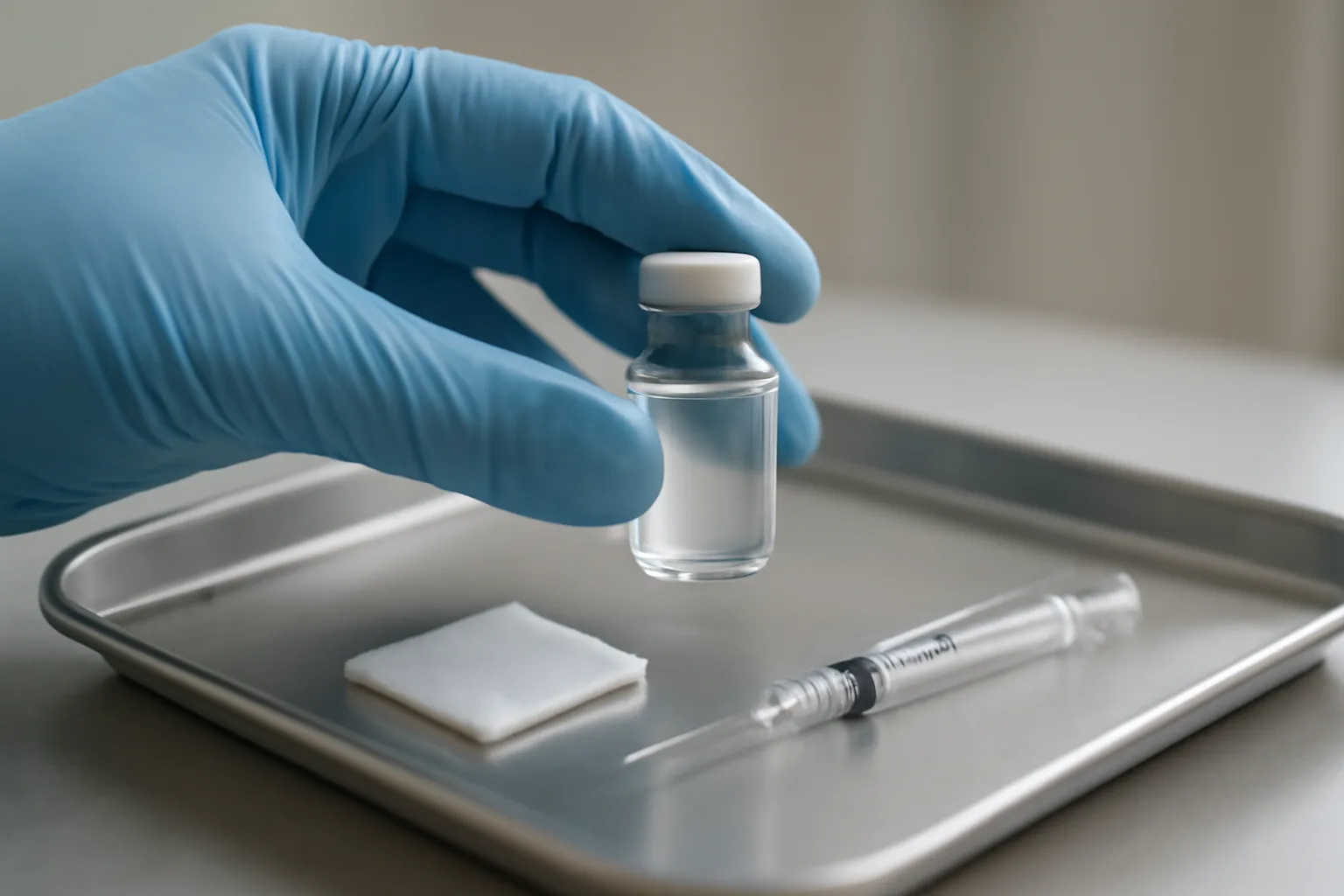
The standard method mirrors how most injectable peptides are handled in compounding and self-administration settings. Here's the sequence. 1. Let the vial reach room temperature if it's been refrigerated or shipped cold. 2. Wipe the rubber stopper with an alcohol swab. 3. Draw bacteriostatic water into a syringe. Most people use somewhere between 1 mL and 3 mL depending on the vial's peptide content and the concentration they want to end up with. 4. Insert the needle at an angle and inject the water slowly down the inside wall of the vial, not directly onto the powder. 5. Do not shake the vial. Swirl it gently, or let it sit for a minute and swirl again, until the powder is fully dissolved. 6. Check the liquid is clear. Cloudiness or visible particles means something went wrong (agitation, contamination, or a bad batch) and that vial shouldn't be used. 7. Label the vial with the date of reconstitution. The reason for the gentle-mixing rule is straightforward. Peptides are chains of amino acids held together by relatively fragile bonds, and hard shaking introduces mechanical stress and air bubbles that can denature the protein, meaning it unfolds or breaks in ways that change or destroy its activity. Slow, wall-directed injection and gentle swirling minimize that stress. This is standard peptide-handling practice across the compounding and research-chemical space, not something specific to AOD-9604.
What liquid should you use, bacteriostatic water or something else?
Bacteriostatic water is the standard choice. It's sterile water with 0.9% benzyl alcohol added, and that benzyl alcohol acts as a preservative that inhibits bacterial growth across multiple uses of the same vial. That's what makes it different from plain sterile water, which has no preservative and is meant to be used once and discarded. Sterile water without preservative can technically be used, but then the vial really should be treated as single-use and discarded same-day, since there's nothing in it stopping bacterial growth once the seal is broken repeatedly. Don't use tap water, saline in place of bacteriostatic water without knowing why, or any liquid that isn't specifically sold as bacteriostatic water or sterile water for injection. This isn't a place to improvise.
How much bacteriostatic water should you add?
This depends on the vial's total peptide content and how you want to dose it, and there's no single universal answer. A 2 mg or 5 mg vial mixed with 2 mL of bacteriostatic water gives you 1 mg per mL or 2.5 mg per mL respectively, and from there the math of what volume to draw for a given dose is straightforward division. More water means a more dilute solution, which some people prefer because it makes small-volume dosing errors less consequential. Less water means a more concentrated solution, which some people prefer because it means fewer injections at higher volume aren't required. If you want the actual arithmetic worked out for your specific vial size, the AOD-9604 dosage calculator walks through concentration and draw volume, and the AOD-9604 dosage page covers what doses have actually shown up in the human trial literature versus what's commonly discussed online. Those two things are not always the same, and that gap matters more here than in most peptide categories.
How do you store AOD-9604 before and after mixing?
Unreconstituted (dry, lyophilized) AOD-9604 is generally kept refrigerated or frozen and is markedly more stable in that state than once it's dissolved. Manufacturers vary on their specific stability claims, and there's no FDA-approved product here to point to for an official stability window, since AOD-9604 has never gone through FDA approval and doesn't appear in the Drugs@FDA database [2]. Once reconstituted, standard peptide-handling guidance calls for refrigeration (not freezing) of the mixed vial, protection from light, and use within roughly 20 to 30 days, though practices vary and this window is a general handling convention rather than a figure verified in an AOD-9604-specific stability study. Freezing a reconstituted vial is generally discouraged because freeze-thaw cycles can degrade peptide structure. Keep the vial away from direct sunlight and heat. A refrigerator door shelf works fine for most people; a bathroom cabinet next to a hot shower does not.
What can go wrong during reconstitution, and how do you know if the vial is bad?
The clearest sign of a problem is cloudiness. A properly reconstituted AOD-9604 solution should be clear, not milky or hazy. Cloudiness after mixing can mean the peptide was shaken too hard, the water introduced contamination, or the underlying powder was compromised before you even opened it. Other warning signs: visible particulate matter floating in the solution, a vial that won't fully dissolve no matter how long you swirl it, or a solution that develops cloudiness days after it looked fine. Any of these mean the vial should be discarded, not used. There's no home test that tells you whether a peptide vial actually contains what the label says, at what purity, or free of contaminants. That's a testing and sourcing problem, not a reconstitution problem, and it's a real limitation of buying peptides in a market where independent verification is inconsistent.
Does reconstitution technique affect whether AOD-9604 actually works?
Reconstitution technique affects whether the peptide you mixed retains its structural integrity. It has no bearing on the separate, much bigger question of whether AOD-9604 does anything meaningful for fat loss in humans at doses people are actually using. This is the part that gets skipped in most reconstitution guides, and it shouldn't be. AOD-9604 went through actual human obesity trials, run by the Australian biotech Metabolic Pharmaceuticals, and the summary in the investigational drugs literature describes it as a modified fragment of hGH's amino acids 177-191 developed specifically to target the fat-metabolizing (lipolytic) activity of growth hormone while minimizing its growth-promoting and blood-sugar effects [1]. That's the rationale, and it's a genuinely clever piece of peptide design on paper. The problem is what happened in the clinic. A broader review of obesity drugs in development covering the same era describes AOD-9604 among a field of candidate compounds being tested for weight-loss efficacy, and the honest summary of the human trial outcomes for AOD-9604 specifically is that the weight-loss signal did not separate convincingly from placebo [3]. That's not a minor asterisk. It's the central fact anyone researching this peptide needs to sit with before spending money on it. A peptide can have a sound mechanistic story, a well-defined amino acid target, and clean pharmacology, and still not beat placebo in the actual humans it was tested on. If you want the full trial history and how it compares to other GH-derived candidates like tesamorelin, the AOD-9604 peptide page and the AOD-9604 vs tesamorelin comparison both go into that record in more depth. Tesamorelin, unlike AOD-9604, is FDA-approved for a specific indication (HIV-associated lipodystrophy) and has actual placebo-controlled efficacy data behind that approval, which puts it in a different evidentiary category entirely.
Is AOD-9604 legal to buy and use, and does that affect how it's sold?
AOD-9604 is not FDA-approved for any use in humans. It does not appear in the Drugs@FDA database of approved drug products [2]. It's also not on either of FDA's bulks lists for compounding: not the 503A bulks list [4] and not the 503B bulks list [5], which means outsourcing facilities and traditional compounding pharmacies operating under 21 U.S.C. 353a don't have a clean regulatory basis to compound it into patient-specific prescriptions the way they might with an approved or listed substance [6]. What you'll find sold online is typically labeled "for research use only" or similar language, which is a legal fiction in a lot of cases given how it's actually marketed and used, but it does mean these products haven't gone through FDA's manufacturing quality oversight, dosing verification, or efficacy review that an approved drug requires. Intended use matters under FDA's own framework: a product's labeling, advertising, and the circumstances of its distribution can establish intended use under 21 CFR 201.128 regardless of what a research-use disclaimer says [7]. This is why sourcing matters as much as reconstitution technique. If you're going to use this compound at all, going through a provider-reviewed route rather than an anonymous online vendor at least puts a clinician's judgment between you and the syringe, even though it doesn't change the underlying trial record. AOD-9604 Co reviews providers along these lines and can point you toward pharmacy partners that fulfill under that kind of oversight rather than shipping a mystery vial with no accountability behind it.
Does AOD-9604 show up on a drug test, and does that matter for reconstitution or use?
This question comes up a lot among people using AOD-9604 alongside sport or competition, so it's worth addressing even though it has nothing to do with mixing technique. A 2013 study in Drug Testing and Analysis specifically examined whether AOD-9604 interferes with or triggers the WADA hGH isoform immunoassay, the test used in anti-doping to detect growth hormone use, and found that AOD-9604 does not influence that assay [8]. Separately, anti-doping science has developed other detection methods aimed specifically at small peptides like AOD-9604 that fall under roughly 2 kilodaltons in size, including direct urine injection combined with liquid chromatography and ion mobility mass spectrometry, described in a 2016 method paper in the Journal of Separation Science [9]. Broader reviews of doping-control analytics have also mapped out approaches for detecting peptidic drugs and analogs generally, including AOD-9604 as one compound of interest in that space [10][11]. The practical takeaway: not triggering the standard hGH isoform test doesn't mean AOD-9604 is undetectable or sanctioned for use in tested sport. Athletes should treat any unapproved peptide as a genuine doping risk regardless of what any single assay does or doesn't catch.
What supplies do you need before you start reconstituting?
Beyond the vial of AOD-9604 itself, the standard supply list is short: bacteriostatic water, alcohol swabs, a syringe with a needle appropriate for drawing (often a larger gauge like 18-23G for drawing the diluent) and a separate, finer needle for injection (commonly 27-31G for subcutaneous use), and a sharps disposal container. A lot of people also want an insulin syringe with fine unit markings for dosing accuracy, since AOD-9604 doses discussed in the literature and in common practice are small, and precision matters more at small volumes. The AOD-9604 dosage calculator is built around exactly this problem, converting a target microgram dose into a specific syringe unit mark once you know your reconstitution concentration. Don't reuse needles across draws and injections. Drawing from a stoppered vial dulls a needle fast, and a dull needle makes subcutaneous injection more uncomfortable and slightly increases tissue trauma at the injection site.
What are the realistic side effects and safety considerations once it's mixed and ready to use?
Reconstitution safety is mostly about sterility technique: clean stopper, clean hands, no reused needles, no cloudy vials. Injection-site safety is a separate topic covered in more depth on the AOD-9604 peptide side effects page, but broadly, injection-site redness, minor swelling, and irritation are the most commonly reported issues with subcutaneous peptide injections generally. A broader safety review of peptide therapies used off-label for musculoskeletal and athletic performance purposes, published in Sports Medicine, covers both FDA-approved and unapproved peptides in this category and points out that unapproved peptides carry meaningfully less safety and efficacy data behind them than approved options, a distinction that applies directly to AOD-9604 [12]. A parallel review in the Journal of the American Academy of Orthopaedic Surgeons Global Research & Reviews covering therapeutic peptides in orthopaedic applications makes a similar point about the gap between mechanistic promise and confirmed clinical benefit for peptides in this broader unapproved category [13]. There's no substitute here for a clinician who knows your health history reviewing what you're doing. Self-directed peptide use without that oversight means nobody is watching for interactions, injection-site complications, or the possibility that a sourced product isn't what its label claims.
Frequently asked questions
How much bacteriostatic water do I mix with AOD-9604?
There's no single fixed answer; it depends on your vial's total peptide content and the concentration you want. Common approaches use 1-3 mL of bacteriostatic water per vial. A 2 mg vial mixed with 2 mL gives 1 mg/mL. Use a dosage calculator to convert your specific vial size and water volume into an actual draw-volume-per-dose number.
Can I use sterile water instead of bacteriostatic water?
You can, but sterile water without preservative has no antibacterial protection, so a vial mixed with it should be treated as single-use and discarded the same day. Bacteriostatic water contains 0.9% benzyl alcohol as a preservative, which is why it's the standard choice for multi-dose peptide vials.
Why shouldn't I shake the vial when reconstituting AOD-9604?
Shaking introduces mechanical stress and air bubbles that can denature the peptide, meaning the protein structure unfolds or breaks in ways that can reduce or destroy its activity. Gentle swirling after slowly injecting water down the vial wall is the standard, lower-stress alternative used across peptide handling generally.
How long does reconstituted AOD-9604 last in the fridge?
General peptide-handling practice suggests refrigerated storage and use within roughly 20-30 days after mixing, though this is a common handling convention rather than a figure confirmed in an AOD-9604-specific stability study, since there's no FDA-approved product with an official stability window to cite here.
Does AOD-9604 actually cause fat loss in humans?
AOD-9604 went through human obesity trials run by Metabolic Pharmaceuticals, and the honest read of those results is that weight loss did not separate convincingly from placebo, despite a plausible fragment-of-hGH mechanistic rationale targeting fat metabolism specifically. That trial outcome is the central fact to weigh before using it, not an afterthought.
Is AOD-9604 FDA approved?
No. AOD-9604 does not appear in the Drugs@FDA database of approved drug products, and it is not on FDA's 503A or 503B bulk drug substance lists used by compounding pharmacies, which limits the regulatory pathway for legitimate compounded prescriptions.
Will AOD-9604 show up on a drug test?
A 2013 study in Drug Testing and Analysis found AOD-9604 does not influence the WADA hGH isoform immunoassay specifically. That doesn't mean it's undetectable by all anti-doping methods; other techniques targeting small peptides under 2 kDa have been developed separately for doping control.
What needle size should I use to reconstitute and inject AOD-9604?
A larger gauge needle (often 18-23G) is typically used to draw bacteriostatic water into the syringe, since it moves liquid faster and won't dull as easily on the rubber stopper. A finer needle (commonly 27-31G) is then used for the actual subcutaneous injection to minimize discomfort.
What does it mean if my reconstituted AOD-9604 vial looks cloudy?
Cloudiness after mixing usually means agitation was too rough, contamination occurred during the process, or the powder was compromised before reconstitution. A properly mixed vial should be clear. Any cloudy, hazy, or particle-containing solution should be discarded rather than injected.
How is AOD-9604 different from full human growth hormone?
AOD-9604 is a 15-amino-acid fragment representing a specific region of the hGH molecule (roughly amino acids 177-191), engineered to isolate the fat-metabolizing activity of growth hormone while minimizing the growth-promoting and blood-sugar-raising effects associated with full-length hGH.
Can I freeze reconstituted AOD-9604 to make it last longer?
Generally, no. Freezing a reconstituted (liquid) peptide vial is usually discouraged because freeze-thaw cycles can physically stress and degrade the dissolved peptide structure. Unreconstituted, dry, lyophilized powder tolerates cold storage, including freezing, much better than the mixed liquid does.
Where should I source AOD-9604 if I decide to use it?
Given the lack of FDA approval and its absence from FDA's compounding bulk lists, sourcing through a provider-reviewed route with clinician oversight is a materially safer choice than buying from an anonymous online vendor. AOD-9604 Co reviews providers and can point toward pharmacy partners that fulfill under that kind of oversight.
Sources
- PubMed, Current Opinion in Investigational Drugs (2004): AOD-9604 is a modified fragment of hGH amino acids 177-191 developed to target lipolytic activity while minimizing growth-promoting and diabetogenic effects
- PubMed, Current Opinion in Investigational Drugs (2006): AOD-9604 was among obesity drug candidates in clinical development whose human trial weight-loss results did not separate convincingly from placebo
- PubMed, Drug Testing and Analysis (2013): AOD-9604 does not influence the WADA hGH isoform immunoassay used in anti-doping testing
- PubMed, Journal of Separation Science (2016): Direct urine injection with liquid chromatography and ion mobility mass spectrometry has been developed to screen for small peptides under 2 kDa
- PubMed, Expert Review of Proteomics (2014): Anti-doping science has developed detection approaches specifically for peptidic drugs, drug candidates, and analogs including compounds like AOD-9604
- PubMed, Journal of Pharmaceutical and Biomedical Analysis (2014): Analytical methods have been developed for detecting emerging therapeutics and non-approved drugs, including peptides, in human doping controls
- PubMed, Sports Medicine (2026): Unapproved peptide therapies used for musculoskeletal and athletic performance purposes carry meaningfully less safety and efficacy data than approved options
- PubMed, JAAOS Global Research & Reviews (2026): A gap exists between mechanistic promise and confirmed clinical benefit for therapeutic peptides used in orthopaedic applications
- FDA, Drugs@FDA database: AOD-9604 does not appear as an FDA-approved drug product in the Drugs@FDA database
- eCFR, 21 CFR 216.23 (503A Bulks List): AOD-9604 is not included on FDA's 503A bulk drug substances list for traditional compounding
- eCFR, 21 CFR 216.24 (503B Bulks List): AOD-9604 is not included on FDA's 503B bulk drug substances list for outsourcing facility compounding
- Cornell Law School LII, 21 U.S.C. 353a: Pharmacy compounding of drug products for identified patients is governed by the conditions set out in 21 U.S.C. 353a
- eCFR, 21 CFR 201.128: A product's labeling, advertising, and distribution circumstances can establish its intended use under FDA regulation regardless of research-use disclaimers